


READING PASSAGE 2
You should spend about 20 minutes on Questions 14-26 which are based on Reading Passage 2 below.
The Giant Panda and Global Warming
Despite giant pandas being the feature attraction of zoos around the world – bringing joy to millions of visitors each year – and despite the birth of a giant panda cub in captivity always being headline news, the survival of giant pandas in the wild is highly uncertain.
This charismatic and universally loved species is one of the rarest and most endangered bears in the world. It was once spread throughout China, northern Vietnam and northern Burma, but now the giant panda is found in the wild in just six isolated mountain ranges in Gansu, Shaanxi and Sichuan Provinces in south-central China. This distinctive black and white creature typically leads a solitary life. It is a good swimmer and an excellent tree climber, but it spends most of its time feeding.
Three-quarters of all wild giant pandas now live in nature reserves, but, despite this, they are still endangered. Nearly half of all wild giant pandas were lost between the early 1970’s and the late 1990’s, mainly owing to habitat destruction and poaching. Habitat loss and fragmentation are still the main threats today and this happens in a variety of ways. For example, roads and railways are increasingly cutting through the forest, which isolates giant panda populations and prevents them from breeding.
It is well known that the giant panda almost exclusively feeds on bamboo, in spite of its taxonomic classification as a meat-eater. Because of this, various scientists from Michigan State University have recently provided comprehensive forecasts of how changing climate may affect the most common species of bamboo that carpet the forest floors of prime giant panda habitat in north-western China. Even the most optimistic scenarios show that bamboo die-offs would effectively cause this giant panda habitat to become inhospitable by the end of the 21st century.
The scientists studied possible scenarios of climate change in the Qinling Mountains in Shaanxi Province. At the northern boundary of China’s giant panda distributional range, the Qinling Mountains are home to about 275 wild giant pandas, which account for 17 per cent of the remaining wild population. The Qinling giant pandas, which have been isolated because of thousands of years of human habitation around the mountain range, vary genetically from other giant pandas. The geographic isolation of these giant pandas makes them particularly valuable for conservation, but susceptible to climate change. The study is meant to help with understanding the impacts of climate change and will provide important information for science to assist in making good decisions, as looking at the climate impact on the bamboo can help conservationists prepare for the challenges that the giant panda will likely face in the future.
Bamboo is a vital part of forest ecosystems, being not only the preferred menu item for giant pandas, but also providing essential food and shelter for other wildlife, including other endangered species, like the ploughshare tortoise and purple-winged ground-dove. However, bamboo can be a risky crop to stake survival on because of its reproductive cycle. The studied species only flower and reproduce every 30 to 35 years, which limits the plant’s ability to adapt to changing climate and can spell disaster for a food supply. Bamboo naturally dies off every 40 to 120 years, depending on the type. Before people dominated their landscape, giant pandas could move from areas where die-offs had occurred to areas with healthy bamboo. But as the human population has expanded and fragmented giant panda habitats, the animals are no longer able to ‘follow’ the bamboo, and so can get stuck in areas without enough food.
The Michigan scientists constructed unique models, using field data on bamboo locality, multiple climate projections and historic data of precipitation, temperature ranges and greenhouse gas emission scenarios to evaluate how the three dominant bamboo species would fare in the Qinling Mountains of China. Not many scientists to date have studied bamboo, but there is limited historical proof found in fossil records that does indicate that bamboo development has followed the benefits and devastation of climate change over time.
The fate of giant pandas will not only be determined by nature, but by humans as well. If, as the study’s models predict, large swathes of bamboo become unavailable because of human- caused land use changes, giant pandas will be deprived of clear, accessible paths between meal sources. The models can point the way for authorities to develop proactive planning to protect areas where the climate increases their potential for providing adequate food sources or to begin making natural bridges to allow giant pandas to escape from bamboo famine.
The results of the Michigan study have shown that giant panda habitat and the effectiveness of protecting this habitat will be severely affected by climate change and their models predict climate change could reduce giant panda habitat by nearly 60 per cent over the next 70 years. The research provides compelling evidence of the need to increase protected area development in many of the ranges of the current giant panda distribution. Independent conservationists have also advised that China needs to ensure increased connectivity between currently existing and potential future suitable territories. However, although the Michigan study does not refer to it, it is clear that more time is needed to decide about maintaining these links between areas of good giant panda habitats and conserving habitats for other species. The key element is haste, before numbers become too low and gene diversity becomes too limited.
Questions 14-18
Complete the summary using the words in the box below.
Write your answers in boxes 14-18 on your answer sheet.
Despite its 14………………., the giant panda is critically endangered and is only found in six wild habitats. Preferring usually to be alone, this easily 15………………. animal likes to swim, climb trees and, for most of its time, feed on bamboo. The giant panda is low on numbers, because of 16………………. And loss of habitat from the 1970’s to the 1980’s. Although officially a 17………………., bamboo is its preferred food. A recent study has shown that global warming will have 18………………. effects on bamboo in giant panda habitat over the next hundred years.
forager hunting
negative found
size carnivore
pollution popularity
identifiable encouraging
Questions 19-23
Answer the questions below.
Write NO MORE THAN THREE WORDS AND/OR A NUMBER from the text for each answer.
Write your answers in boxes 19-23 on your answer sheet.
19 What proportion of wild giant pandas live in the Qinling Mountains?
20 What is the reason that makes the giant panda so vulnerable to changes in the climate?
21 What aspect of bamboo makes it a dangerous sole food source?
22 Where did scientists find evidence that bamboo growth and decline mirrors negative and positive climate change?
23 What can authorities create to let giant pandas move to different habitats in order to avoid starvation?
Questions 24-26
Complete each sentence with the correct ending (A – E) below.
Write the correct letter (A – E) in answer boxes 24-26 on your answer sheet.
24 The Michigan study has revealed climate change will lead to
25 The Michigan study has advised those responsible to
26 More time is needed in order to agree on how to
A heavier rainfall in giant panda habitats.
B allow giant pandas to move between different population habitats.
C major changes in giant panda habitats.
D increase the number of breeding programs in zoos.
E increase the amount of areas where the giant panda can have protected status.
READING PASSAGE 3
You should spend about 20 minutes on Questions 27-40 which are based on Reading Passage 3 below.
Antibiotic Resistance
An antibiotic is a drug that kills or prevents the growth of bacteria. The term ‘antibiotic’, coined by Selman Waksman, originally described only those antibiotics derived from living bodies, in contrast to ‘chemotherapeutic agents’, which are purely synthetic. Currently, the term antibiotic is also applied to synthetic antimicrobials.
Overuse or misuse of antibiotics may result in the development of antibiotic resistance in the infecting organisms, similar to the development of pesticide resistance in insects. Doctor Iain Nicholson explains. “The concept of genetic selection requires that as close as possible to 100 per cent of the infecting organisms be killed off to avoid selection of resistance. If a small subset of the population survives the treatment and is allowed to multiply, the average susceptibility of this new population to the compound will be much less than that of the original population, since they have descended from those few organisms that survived the original treatment.”
Antibiotic resistance has become a serious problem in both developed and underdeveloped nations. In certain settings, such as hospitals, the rate of antibiotic resistance is so high today that the normal, low-cost antibiotics are virtually useless for the treatment of frequently seen infections. This leads to more common use of newer and more expensive compounds, which in turn leads to the rise of resistance to those drugs. Drug company spokesperson, Emma Thompson, explains the challenge facing the drug industry. “A continuous race to discover new and different antibiotics results in an attempt to keep humanity from losing ground in the battle against infection. The fear is that we will eventually fail to keep up in this race, and that people may again face life-threatening bacterial infections.”
An example of antibiotic resistance is Staphylococcus aureus, which used to be treated successfully with penicillin in the 1940’s and 1950’s. At present, nearly all strains are resistant to penicillin, and many are resistant to other antibiotics, leaving only a narrow selection of drugs useful for treatment. The situation is worsened by the fact that gene coding for antibiotic resistance can be transferred between bacteria, making it possible for bacteria never exposed to an antibiotic to acquire resistance from those which have.
Microbial resistance to antibiotics is a natural consequence of selective pressures placed on bacteria. However, humans have greatly accelerated the evolution of resistant bacteria by the overuse and misuse of antibiotics in the community. Government health official, Georgina Haynes, explains. “One of the major problems is when antibiotics are used to treat disorders for which they have no efficacy, such as the common cold or other viral complaints, and when they are used widely as prophylaxis rather than treatment, because this exposes more bacteria to selection for resistance.” Similarly, in order to kill all the bacteria of an infection, antibiotics must be used for a whole course and not stopped just when symptoms improve. The discoverer of penicillin himself, Alexander Fleming, warned the scientific community: “The administration of too small doses leads to the production of resistant strains of bacteria.” This can happen due to patient ignorance and to improper pharmacy actions, usually in the developing world. In developing countries, antibiotic prescriptions are often broken up. For example, in some Asian countries, it is common for pharmacies to sell as many tablets as the patient can afford, which may only be two or three. This is an insufficient dose to cure infection and will only further contribute to the evolution of resistant strains of bacteria. Recent reports have also shown that containers of medicine from some African countries sometimes contain only half the drug content that was indicated on the label. This may be due to ‘counterfeit’ medicines or improper storage, but also tropical conditions, such as those often found in Africa, readily cause degradation of medical compounds. Chenbo Okonkwa, a pharmaceutical wholesaler, describes the problem. “Although local regulations may require pharmacies to store drugs in air-conditioned premises, most undergo frequent power outages and warehouses are rarely kept cool. Furthermore, unauthorised dealers rarely bother to follow official storage guidelines.”
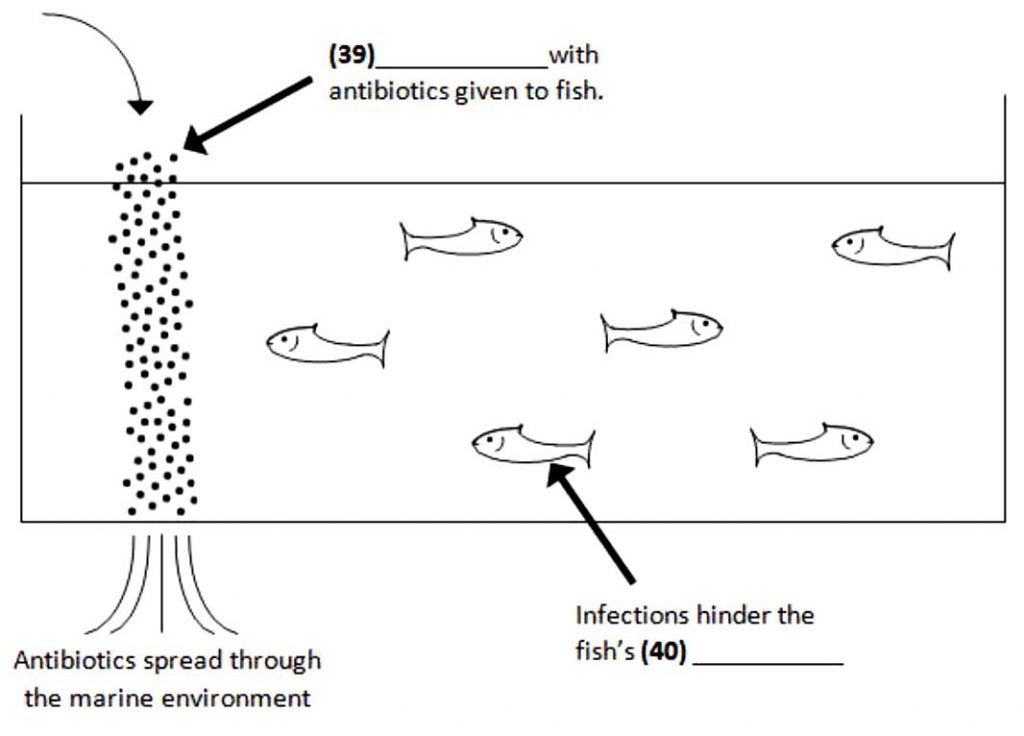
Another problem contributing to antibiotic resistance is that antibiotics are widely used in foodproducing animals, which contributes to the emergence of antibiotic-resistant bacteria in them. These resistant bacteria can contaminate the foods that come from these animals, and persons who consume these foods can develop antibiotic-resistant infections. This can be seen, for instance, in the fish farm industry. It is common to put upwards of 100,000 fish into each pen, which creates cramped and stressful conditions. This increases the susceptibility of fish to certain bacterial diseases, such as furunculosis. Furunculosis, an infection of the kidneys, is easily transmitted through water and so is devastating to fish farms. To combat the disease, antibiotics were added to fish food pellets, but these were unpalatable to the fish. They were already suffering from loss of appetite due to their infections and so most of the antibiotics ended up at the bottom of the pens, allowing residual drugs to spread throughout the marine environment. Fish farmer, Jo Hardwick, explains that this is different now. “Today, vaccines are replacing the antibiotic pellets as a treatment for the disease, but unfortunately, most of the damage has already been done.”
In conclusion, antibiotics must be used judiciously in humans and animals, because both uses contribute to the emergence, persistence, and spread of resistant bacteria. Resistant bacteria in foodproducing animals are of particular concern. Food animals serve as a reservoir of resistant pathogens and resistance mechanisms that can directly or indirectly result in antibiotic resistant infections in humans. If people do not wish to be faced with an attack of all the diseases they thought they had conquered in the twentieth century, society has to change its approach to antibiotic use.
Questions 27-33
Look at the following statements (questions 27-33) and the list of people below.
Match each statement with the correct person’s initials.
Write the correct initials in boxes 27-33 on your answer sheet.
27 Resistant bacteria can develop if doctors do not prescribe enough antibiotic.
28 Society may again have to face infectious diseases that were previously thought treatable.
29 Using antibiotics as a preventative measure is a key factor in the development of antibiotic resistance.
30 Better practice in fish farms when dealing with disease is too late when it comes to the spread of antibiotics in the environments around fish farms.
31 Drug companies may not be able to keep finding new antibiotics to fight lethal resistant infections.
32 All a patient’s infection must be destroyed by prescribed antibiotics in order to stop resistance growing.
33 Illicit antibiotic salesmen hardly ever follow the instructions for keeping antibiotics in the right way.
IN Iain Nicholson
ET Emma Thompson
GH Georgina Haynes
AF Alexander Fleming
CO Chenbo Okonkwa
JH Jo Hardwick
Questions 34-38
Do the following statements agree with the information given in the text?
In boxes 34-38 on your answer sheet write:
TRUE if the statement agrees with the information
FALSE if the statement contradicts the information
NOT GIVEN if there is no information on this
34 The current definition of an antibiotic only includes drugs originating from live organisms.
35 Antibiotic resistance is a significant issue in both first and second world countries.
36 Some hospitals nowadays have to fund new antibiotic research themselves.
37 Climate conditions in some parts of Africa can damage antibiotics in their containers.
38 Resistant bacteria in food cannot be passed on to humans who eat it.
Questions 39 and 40
Label the diagram below.
Write NO MORE THAN THREE WORDS from the text for each answer.
Write your answers in boxes 39 and 40 on your answer sheet.
The Misuse of Antibiotics in the Fish Farm Industry
Passage 1
1. vii
2. ii
3. iv
4. i
5. v
6. viii
7. C
8. D
9. B
10. A
11. B
12. C
13. E
Passage 2
14. popularity
15. identifiable
16. hunting
17. carnivore
18. negative
19. 17%
20. (The) (geographic) isolation
21. (Its) reproductive cycle
22. (In) fossil records
23. (Natural) bridges
24. C
25. E
26. B
Passage 3
27. AF
28. ET
29. GH
30. JH
31. ET
32. IN
33. CO
34. FALSE
35. TRUE
36. NOT GIVEN
37. TRUE
38. FALSE
39. (Fish) (food) pellets/ (fish) food
40. appetite

Bình luận