


READING PASSAGE 1
You should spend about 20 minutes on Questions 1-13 which are based on Reading Passage 1 below.
MÁRQUEZ AND MAGICAL REALISM
A
When Gabriel García Márquez died in 2014, he was mourned around the world, as readers recalled his 1967 novel, One hundred years of solitude, which has sold more than 25 million copies, and led to Márquez ‘s receipt of the 1982 Nobel Prize for Literature.
B
Born in 1927, in a small town on Colombia’s Caribbean coast called Aracataca, Márquez was immersed in Spanish, black, and indigenous cultures. In such remote places, religion, myth, and superstition hold sway over logic and reason or perhaps operate as parallel belief systems. Certainly, the ghost stories told by his grandmother affected the young Gabriel profoundly, and a pivotal character in his 1967 epic is indeed a ghost.
Márquez’s family was not wealthy: there were twelve children, and his father worked as a postal clerk, a telegraph operator, and an occasional pharmacist. Márquez spent much of his childhood in the care of his grandparents, which may account for the main character in One hundred years of solitude resembling his maternal grandfather. Although Márquez left Aracataca aged eight, the town and its inhabitants never seemed to leave him, and suffuse his fiction.
C
One hundred years of solitude was the fourth of fifteen novels, but Márquez was an equally passionate and prolific journalist.
In Bogota, during his twenties and thirties, Márquez experienced La Violencia, a period of great political and social upheaval, when around 300,000 Colombians were killed. Certainly, life was never safe for journalists, and after writing an article on corruption in the Colombian navy in 1955, Márquez was forced to flee to Europe. Incidentally, in Paris, he discovered that European culture was not richer than his own, and he was disappointed by Europeans who were patronising towards Latin Americans. On return to the southern hemisphere, Márquez wrote for Venezuelan newspapers and the Cuban press agency.
D
In terms of politics, Márquez was leftwing. In Chile, he campaigned against the dictatorship of General Augusto Pinochet; in Venezuela, he financed a political party; and, in Nicaragua, he defended revolutionaries. He considered Fidel Castro, the President of Cuba, as a dear friend. Since the US was hostile towards Castro’s communist regime, which Márquez supported, the writer was banned from visiting the US until invited by President Clinton in 1995. The novels of Márquez are imbued with his politics, but this does not prevent readers from enjoying a good yarn.
E
Márquez maintained that in Latin America so much that is real would seem fantastic elsewhere, while so much that is magical seems real. He was an exponent of a genre known as Magical Realism.
‘If you can explain it,’ said the Mexican critic, Luis Leal, ‘then it’s not Magical Realism.’ This demonstrates the difficulty of determining what the genre encompasses and which writers belong to it.
The term Magical Realism is usually applied to literature, but its first use was probably in 1925 when a German art critic reviewed paintings similar to those of Surrealism.
Many critics define Magical Realism by what it is not. Realism describes lives that could be real; Magical Realism uses the detail and the tone of a realist work but includes the magical as though it were real. The ghosts in One hundred years of solitude and in the American Toni Morison’s Beloved are presented by their narrators as normal, so readers accept them unhesitatingly. Likewise, a character can live for 200 years in a Magical Realist novel. Surrealism explores dream states and psychological experiences; Magical Realism does not. Science Fiction describes a new or an imagined world, as in Aldous Huxley’s Brave New World, but Magical Realism depicts the real world. Nor is Magical Realism fantasy, like Franz Kafka’s Metamorphosis, in which an ordinary man awakens to find he has transformed into a cockroach. This is because the writer and the reader of that story cannot decide whether to ascribe natural or supernatural causes to the event. In contrast, in a work by Márquez, the world is both natural and supernatural, both rational and irrational, and this binary nature fascinates readers.
Magical Realism does share some common ground with post-modernism since the acts of writing and breading are self-reflexive. A narrative may not be linear, but may double back on itself, or be discontinuous, and the notion of character is more illusive than in other genres.
Naturally, some of these elements disturb a reader although the enormous success of One hundred years of solitude and the hundreds of other Magical Realist works from authors as far apart as Norway, Nigeria, and New Zealand would seem to belie it.
F
Latin America has had a long history of conquest, revolution, and dictatorship; of hunger, poverty, and chaos, yet, at the same time, is endowed with rich cultures, with warm, emotional people, many of whom, like Márquez, remain optimistically utopian. Gabriel Garcia Márquez has passed away, but his fiction will certainly endure.
Questions 1-7
Passage 1 has six sections, A-F.
Which section contains the following information?
Write the correct letter, A-F, in boxes 1-7 on your answer sheet.
NB: You may use any letter more than once.
1 Márquez ‘s background
2 how Márquez felt about Europe
3 influences on Márquez
4 the extent of Márquez ‘s fame
5 why the US did not welcome Márquez
6 what constitutes a Magical Realist work
7 other writing important to Márquez
Questions 8-13
Complete the summary below using the dates or words, A-L, below.
Write the correct letter, A-L, in boxes 8-13 on your answer sheet.
A accept B adapting C adopting
D believes E fantasy F non-linear
G novel H rational I supernatural
J use K 1925 L 1927
What is Magical Realism?
The genre of Márquez ‘s fiction is known as Magical Realism, a term first applied to a painting in 8………………… Magical Realism is often described in negative terms, as not being Realism, Surrealism, Science Fiction, or 9…………………
In a Magical Realist novel, the world people live in – which is the real world – is described in detail, but magical or 10……………….. elements intrude. These are treated like real ones so that a reader 11……………….. them. For instance, characters live longer than natural lives, and ghosts exist. Time, in a Magical Realist work, may also be 12…………………
Despite requiring a suspension of disbelief by readers, Magical Realism has enjoyed great success, with writers from all over the world 13……………….. the style.
READING PASSAGE 2
You should spend about 20 minutes on Questions 14-27 which are based on Reading Passage 2 below.
Recent stock-market crashes
For as long as there have been financial markets, there have been financial crises. Most economists agree, however, that from 1994 to 2013 crashes were deeper and the resultant troughs longer-lasting than in the 20-year period leading up to 1994. Two notable crashes, the Nifty Fifty in the mid-l 970s and Black Monday in 1987, had an average loss of about 40% of the value of global stocks, and recovery took 240 days each, whereas the Dot-com and credit crises, post-1994, had an average loss of about 52%, and endured for 430 days. What economists do not agree upon is why recent crises have been so severe or how to prevent their recurrence.
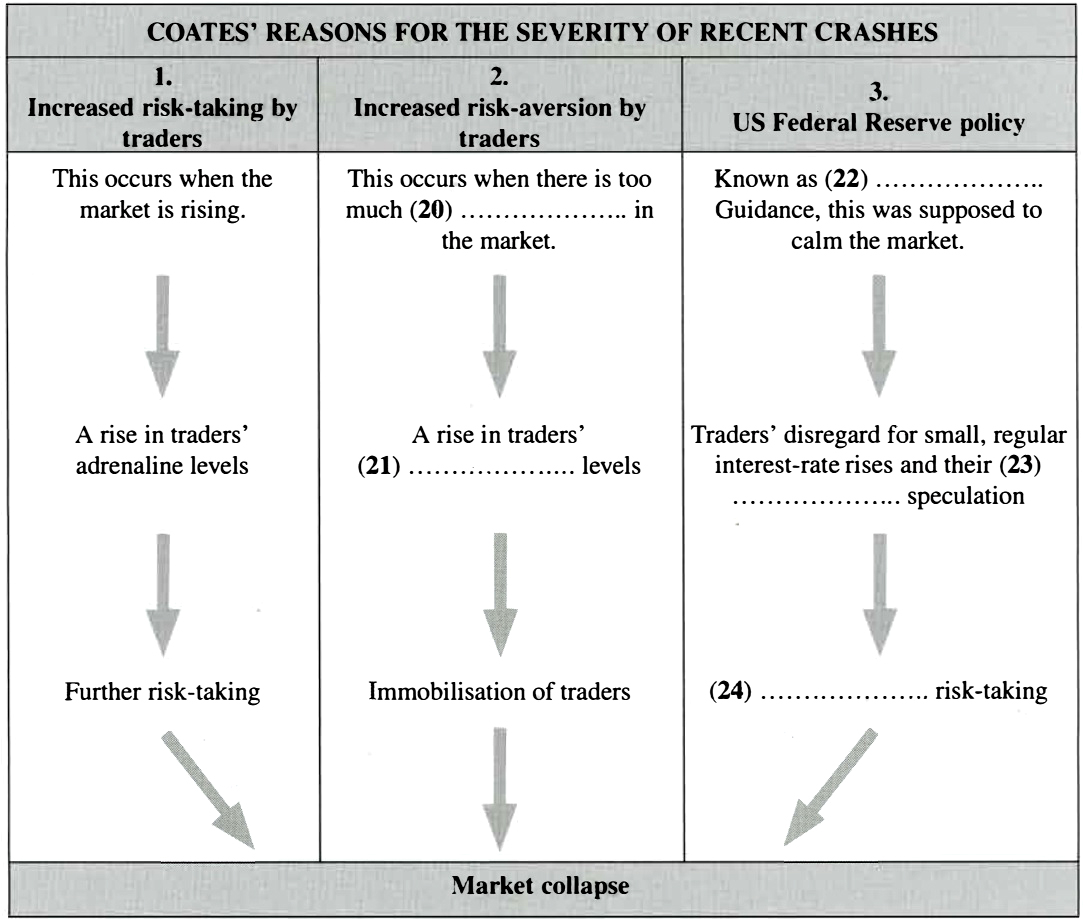
John Coates, from the University of Cambridge in the UK and a former trader for Goldman Sachs and Deutsche Bank, believes three separate but related phenomena explain the severity. The first is dangerous but predictable risk-taking on the part of traders. The second is a lack of any risk-taking when markets become too volatile. (Coates does not advocate risk-aversion since risk-taking may jumpstart a depressed market.) The last is a new policy of transparency by the US Federal Reserve – known as the Fed – that may have encouraged stock-exchange complacency, compounding the dangerous risk-taking.
Many people imagine a trader to have a great head for maths and a stomach for the rollercoaster ride of the market, but Coates downplays arithmetic skills, and doubts traders are made of such stern stuff. Instead, he draws attention to the physiological nature of their decisions. Admittedly, there are women in the industry, but traders are overwhelmingly male, and testosterone appears to affect their choices.
Another common view is that traders are greedy as well as thrill-seeking. Coates has not researched financial incentive, but blood samples taken from London traders who engaged in simulated risk-taking exercises for him in 2013 confirmed the prevalence of testosterone, cortisol, and dopamine – a neurotransmitter precursor to adrenalin associated with raised blood pressure and sudden pleasure.
Certainly anyone faced with danger has a stress response involving the body’s preparation for impending movement – for what is sometimes called ‘Fight or flight’, but, as Coates notes, any physical act at all produces a stress response: even a reader’s eye movement along words in this line requires cortisol and adrenalin. Neuroscientists now see the brain not as a computer that acts neutrally, involved in a process of pure thought, but as a mechanism to plan and carry out a movement, since every single piece of information humans absorb has an attendant pattern of physical arousal.
For muscles to work, fuel is needed, so cortisol and adrenalin employ glucose from other muscles and the liver. To burn the fuel, oxygen is required, so slightly deeper or faster breathing occurs. To deliver fuel and oxygen to the body, the heart pumps a little harder and blood pressure rises. Thus, the stress response is a normal part of life, as well as a resource in fighting or fleeing. Indeed, it is a highly pleasurable experience in watching an action movie, making love or pulling off a multi-million-dollar stock-market deal.
Cortisol production also increases during exposure to uncertainty. For example, people who live next to a train line adjust to the noise of passing trains, but visitors to their home are disturbed. The phenomenon is equally well-known of anticipation being worse than an event itself: sitting in the waiting room thinking about a procedure may be more distressing than occupying the dentist’s chair and having one. Interestingly, if a patient does not know approximately when he or she will be called for that procedure, cortisol levels are the most elevated of all. This appeared to happen with the London traders participating in some of Coates’ gambling scenarios.
When there is too much volatility in the stock market, Coates suspects adrenaline levels decrease while cortisol levels increase, explaining why traders take fewer risks at that time. In fact, typically traders freeze, becoming almost incapable of buying or selling anything but the safest bonds. In Coates’ opinion, the market needs investment as it falls and at rock bottom – at such times, greed is good.
The third matter – the behaviour of the Fed – Coates thinks could be controlled, albeit counterintuitively. Since 1994, the US Federal Reserve has adopted a policy called Forward Guidance. Under this, the public is informed at regular intervals of the Fed’s plans for short-term interest rates. Recently, rates have been raised by small but predictable increments. By contrast, in the past, the machinations of the Fed were largely secret, and its interest rates fluctuated apparently randomly. Coates hypothesises these meant traders were on guard and less likely to indulge in wild speculation. In introducing Forward Guidance, the Fed hoped to lower stock and housing prices; instead, before the crash of 2008, the market surged from further risk-taking, like an unleashed pit bull terrier.
There are many economists who disagree with Coates, but he has provided some physiological evidence for both traders’ recklessness and immobilisation and made the radical proposal of greater opacity at the Fed. Although, as others have noted, we could just let more women onto the floor.
Questions 14-19
Choose the correct letter A, B, C, or D.
Write the correct letter in boxes 14-19 on your answer sheet.
14 What do most economists agree about the financial crashes from 1994 to 2013?
A They were the worst global markets had ever experienced.
B Global stocks fell around 40% for a period of 240 days.
C They were particularly acute in the US.
D They were more severe than those between 1974 and 1993.
15 What does John Coates think about risk-taking among stock-market traders?
A It is almost invariably dangerous.
B It was prevalent at Goldman Sachs and Deutsche Bank.
C It should be regulated by the US Federal Reserve.
D It can sometimes assist a weak market.
16 What is some popular belief about traders?
A They are clever, calm, and acquisitive.
B They are usually men who are good at maths.
C They love danger and seek it out.
D They do not deserve their high salaries.
17 What did Coates find in blood samples from London traders in 2013?
A They had high levels of testosterone and dopamine.
B They produced excessive glucose and oxygen.
C They experienced high blood pressure.
D They drank large amounts of alcohol.
18 How do neuroscientists now view the brain?
A As an extraordinary computer.
B As an organ to control movement.
C As the main producer of adrenaline and cortisol.
D As a significant enhancer of pleasure.
19 Why might a person wait to see a dentist have extremely high cortisol levels?
A He or she may dislike going to the dentist.
B He or she may be worried about the procedure.
C He or she may not have a specific appointment.
D He or she may not be able to afford the consultation.
Questions 20-24
Complete the flowchart below.
Choose ONE WORD ONLY from the passage for each answer
Write your answers in boxes 20-24 on your answer sheet.
Questions 25-27
Do the following statements agree with the claims of the writer in Passage 2?
In boxes 25-27 on your answer sheet, write:
YES if the statement agrees with the claims of the writer.
NO if the statement contradicts the claims of the writer.
NOT GIVEN if it is impossible to say what the writer thinks about this.
25 Coates’ views are held by many other economists.
26 Coates’ suggestion of less transparency at the Fed is sound.
27 Raising the number of female traders may solve the problem.
Passage 1
1. B
2. C
3. B
4. A
5. D
6. E
7. C
8. K
9. E
10. I
11. D
12. F
13. C
Passage 2
14. D
15. D
16. C
17. A
18. B
19. C
20. volatility
21. cortisol
22. Forward
23. wild
24. Further
25. NO
26. NOT GIVEN
27. YES
Passage 3
28. A
29. D
30. A
31. B
32. C
33. B
34. autonomous
35. non-human persons
36. habeas corpus
37. protection
38. all
39. succeeded
40. perceptions

Bình luận