


READING PASSAGE 1
You should spend about 20 minutes on Questions 1-13 which are based on Reading Passage 1 below.
Health in the Wild
Many animals seem able to treat their illnesses themselves. Humans may have a thing or two to learn from them.
A
For the past decade Dr Engel, a lecturer in environmental sciences at Britain’s Open University, has been collating examples of self-medicating behaviour in wild animals. She recently published a book on the subject. In a talk at the Edinburgh Science Festival earlier this month, she explained that the idea that animals can treat themselves has been regarded with some scepticism by her colleagues in the past. But a growing number of animal behaviourists now think that wild animals can and do deal with their own medical needs.
B
One example of self-medication was discovered in 1987. Michael Huffman and Mohamedi Seifu, working in the Mahale Mountains National Park in Tanzania, noticed that local chimpanzees suffering from intestinal worms would dose themselves with the pith of a plant called Veronia. This plant produces poisonous chemicals called terpenes. Its pith contains a strong enough concentration to kill gut parasites, but not so strong as to kill chimps (nor people, for that matter; locals use the pith for the same purpose). Given that the plant is known locally as “goat-killer”, however, it seems that not all animals are as smart as chimps and humans. Some consume it indiscriminately and succumb.
C
Since the Veronia-eating chimps were discovered, more evidence has emerged suggesting that animals often eat things for medical rather than nutritional reasons. Many species, for example, consume dirt a behaviour known as geophagy. Historically, the preferred explanation was that soil supplies minerals such as salt. But geophagy occurs in areas where the earth is not a useful source of minerals, and also in places where minerals can be more easily obtained from certain plants that are known to be rich in them. Clearly, the animals must be getting something else out of eating earth.
D
The current belief is that soil—and particularly the clay in it—helps to detoxify the defensive poisons that some plants produce in an attempt to prevent themselves from being eaten. Evidence for the detoxifying nature of clay came in 1999, from an experiment carried out on macaws by James Gilardi and his colleagues at the University of California, Davis. Macaws eat seeds containing alkaloids, a group of chemicals that has some notoriously toxic members, such as strychnine. In the wild, the birds are frequently seen perched on eroding riverbanks eating clay. Dr Gilardi fed one group of macaws a mixture of harmless alkaloid and clay, and a second group just the alkaloid. Several hours later, the macaws that had eaten the clay had 60% less alkaloid in their bloodstreams than those that had not, suggesting that the hypothesis is correct.
E
Other observations also support the idea that clay is detoxifying. Towards the tropics, the amount of toxic compounds in plants increases-and so does the amount of earth eaten by herbivores. Elephants lick clay from mud holes all year round, except in September when they are bingeing on fruit which, because it has evolved to be eaten, is not toxic. And the addition of clay to the diets of domestic cattle increases the amount of nutrients that they can absorb from their food by 10-20%.
F
A third instance of animal self-medication is the use of mechanical scours to get rid of gut parasites, in 1972 Richard Wrangham, a researcher at the Gombe Stream Reserve in Tanzania, noticed that chimpanzees were eating the leaves of a tree called Aspilia. The chimps chose the leaves carefully by testing them in their mouths. Having chosen a leaf, a chimp would fold it into a fan and swallow it. Some of the chimps were noticed wrinkling their noses as they swallowed these leaves, suggesting the experience was unpleasant. Later, undigested leaves were found on the forest floor.
G
Dr Wrangham rightly guessed that the leaves had a medicinal purpose—this was, indeed, one of the earliest interpretations of a behaviour pattern as self-medication. However, he guessed wrong about what the mechanism was. His (and everybody else’s) assumption was that Aspilia contained a drug, and this sparked more than two decades of phytochemical research to try to find out what chemical the chimps were after. But by the 1990s, chimps across Africa had been seen swallowing the leaves of 19 different species that seemed to have few suitable chemicals in common. The drug hypothesis was looking more and more dubious.
H
It was Dr Huffman who got to the bottom of the problem. He did so by watching what came out of the chimps, rather than concentrating on what went in. He found that the egested leaves were full of intestinal worms. The factor common to all 19 species of leaves swallowed by the chimps was that they were covered with microscopic hooks. These caught the worms and dragged them from their lodgings.
I
Following that observation, Dr Engel is now particularly excited about how knowledge of the way that animals look after themselves could be used to improve the health of livestock. People might also be able to learn a thing or two, and may, indeed, already have done so. Geophagy, for example, is a common behaviour in many parts of the world. The medical stalls in African markets frequently sell tablets made of different sorts of clays, appropriate to different medical conditions.
J
Africans brought to the Americas as slaves continued this tradition, which gave their owners one more excuse to affect to despise them. Yet, as Dr Engel points out, Rwandan mountain gorillas eat a type of clay rather similar to kaolinite – the main ingredient of many patent medicines sold over the counter in the West for digestive complaints. Dirt can sometimes be good for you, and to be “as sick as a parrot” may, after all, be a state to be desired.
Questions 1-4
Do the following statements agree with the information given in Reading Passage 1?
In boxes 1-4 on your answer sheet, write
TRUE if the statement is true
FALSE if the statement is false
NOT GIVEN if the information is not given in the passage
1 It is for 10 years that Dr Engel has been working on animal self-medication.
2 In order to find plants for medication, animals usually need to walk a long distance.
3 Birds such as Macaw, are seen eating clay because it is a part of their natural diet.
4 According to Dr Engel, it is exciting that research into animal self-medication can be helpful in the invention of new painkillers.
Questions 5-9
Complete the notes below using NO MORE THAN ONE WORD from the passage.
Write your answers in boxes 5-9 on your answer sheet.
|
Date |
Name |
Animal |
Food |
Mechanism |
|
1987 |
Michael Huffman and Mohamedi Seifu |
Chimpanzee |
5……………… of Veronia |
Contained chemicals named 6……………… which can kill parasites |
|
1999 |
James Gilardi and his colleagues |
Macaw |
Seeds (contain 7………………) and clay |
Clay can 8……………… the poisonous contents in food |
|
1972 |
Richard Wrangham |
Chimpanzee |
Leaves with tiny 9……………… on surface |
Such leaves can catch and expel worms from intestines |
Questions 10-13
Complete the summary below using words from the box.
Write your answers, A-H, in boxes 10-13 on your answer sheet.
Though often doubted, the self-medicating behaviour of animals has been supported by an increasing amount of evidence. One piece of evidence particularly deals with 10………………….., a soil-consuming behaviour commonly found across animals species, because the earth, often clay, can neutralize the 11………………….. content of their diet. Such behaviour can also be found among humans in Africa, where people purchase 12………………….. at market stalls as a kind of medication to their illnesses. Another example of this is found in chimps eating leaves of often 13………………….. taste but with no apparent medicinal value until its unique structure came into light.
A mineral B plants C unpleasant D toxic
E clay tablets F nutritional G geophagy H harmless
READING PASSAGE 2
You should spend about 20 minutes on Questions 14-26 which are based on Reading Passage 2 below.
Bestcom
CONSIDERATE COMPUTING
A
“YOUR BATTERY IS NOW FULLY CHARGED,” ANNOUNCED THE LAPTOP COMPUTER to its owner, Donald A. Norman, with enthusiasm – perhaps even a hint of pride? – in its synthetic voice. To be sure, distractions and multitasking are hardly new to the human condition. “A complicated life, continually interrupted by competing requests for attention, is as old as procreation,” laughs Ted Selker of the Massachusetts Institute of Technology Media Lab. But increasingly, it is not just our kids pulling us three ways at once; it is also a relentless barrage of e-mail, alerts, alarms, calls, instant messages and automated notifications, none of them coordinated and all of them oblivious to whether we are busy – or even present. “It’s ridiculous that my own computer can’t figure out whether I’m in front of it, but a public toilet can,” exclaims Roel Vertegaal of Queen’s University in Ontario.
B
Humanity has connected itself through roughly three billion networked telephones, computers, traffic lights – even refrigerator and picture frames – because these things make life more convenient and keep us available to those we care about. So although we could simply turn off the phones, close the e-mail program, and shut the office door when it is time for a meeting or a stretch of concentrated work, we usually don’t. We just endure the consequences.
C
Numerous studies have shown that when people are unexpectedly interrupted, they not only work less efficiently but also make more mistakes. “It seems to add cumulatively to a feeling of frustration,” Picard reports, and that stress response makes it hard to regain focus. It isn’t merely a matter of productivity and the pace of life. For pilots, drivers, soldiers and doctors, errors of inattention can be downright dangerous. “If we could just give our computers and phones some understanding of the limits of human attention and memory, it would make them seem a lot more thoughtful and courteous,” says Eric Horvitz of Microsoft Research. Horvitz, Vertegaal, Selker and Picard are among a small but growing number of researchers trying to teach computers, phones, cars and other gadgets to behave less like egocentric oafs and more like considerate colleagues.
D
“Attentive” computing systems have begun appearing in newer Volvos and IBM has introduced Websphere communications software with a basic busyness sense. Microsoft has been running extensive in-house tests of a much more sophisticated system since 2003. Within a few years, companies may be able to offer every office worker a software version of the personal receptionist that only corner-suite executives enjoy today. But if such an offer should land in your inbox, be sure to read the print before you sign. An attentive system, by definition, is one that is always watching. That considerate computer may come to know more about your work habits than you do.
E
Most people aren’t as busy as they think they are, which is why we can usually tolerate interruptions from our inconsiderate electronic paraphernalia. James Fogarty and Scott E. Hudson of Carnegie Mellon University recently teamed up with Jennifer Lai of IBM Research to study 10 managers, researchers and interns at work. They videotaped the subjects and periodically had them rate their “interruptibility.” The amount of time the workers spent in leave-me-alone mode varied from person to person and day to day, ranging from 10 to 51 percent. On average, the subjects wanted to work without interruption about one third of the time. In studies of Microsoft employees, Horvitz has similarly found that they typically spend more than 65 percent of their day in a state of low attention.
F
Today’s phones and computers, which naively assume that the user is never too busy to take a call, read an email, or click “OK” on an alert box, thus are probably correct about two thirds of time. To be useful, then, considerate systems will have to be more than 65 percent accurate in sensing when their users are near their cognitive limits.
G
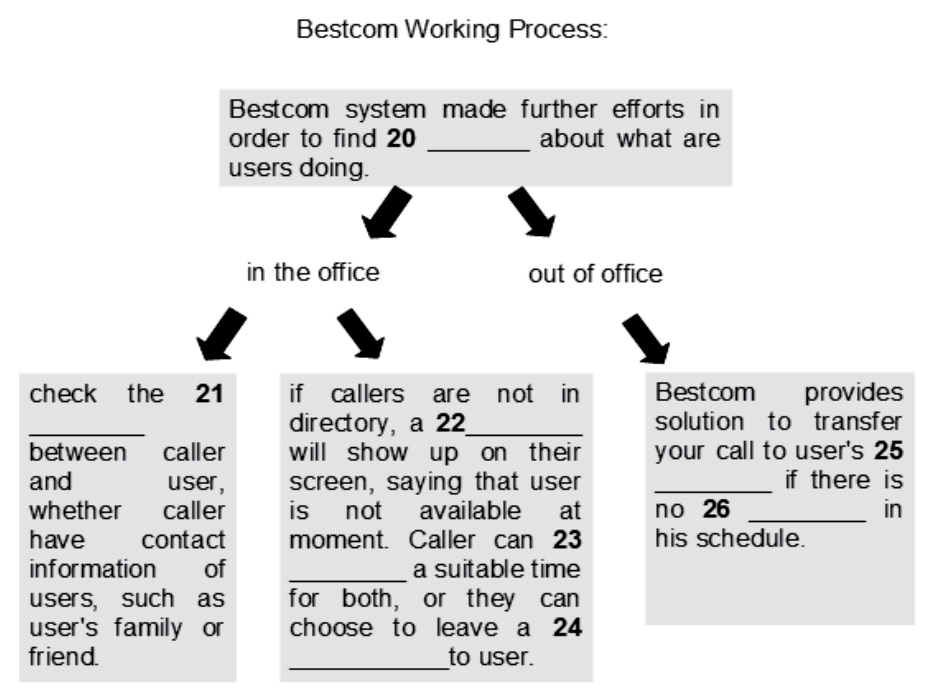
Bestcom/Enhanced Telephony, a Microsoft prototype based on Horvitz’s work, digs a little deeper into each user’s computer to find clues about what they are up to. Microsoft launched an internal beta test of the system in mid-2003. By last October, Horvitz says, about 3,800 people were using the system to field their incoming phone calls.
H
Horvitz himself is one of those testers, and while we talk in his office in Redmond, Wash., Bestcom silently handles one call after another. First it checks whether the caller is listed in his address book, the company directory, or its log of people he has called recently. Triangulating these sources, it tries to deduce their relationship. Family members, supervisors and people he called earlier today ring through. Others see a message on their computer that he is in a meeting and won’t be available until 3 P.M. The system scans Horvitz’s and the caller’s calendar and offers to reschedule the call at a time that is open for both. Some callers choose that option; others leave voice mail. E-mail messages get a similar screening. When Horvitz is out of the office, Bestcom automatically offers to forward selected callers to his cellphone – unless his calendar and other evidence suggest that he is in a meeting.
I
Most large companies already use computerized phone systems and standard calendar and contact management software, so tapping into those “sensors” should be straightforward. Not all employees will like the idea of having a microphone on all the time in their office, however, nor will everyone want to expose their datebook to some program they do not ultimately control. Moreover, some managers might be tempted to equate a “state of low attention” with “goofing off” and punish those who seem insufficiently busy.
Questions 14-19
Do the following statements agree with the information given in Reading Passage 2?
In boxes 14-19 on your answer sheet, write
TRUE if the statement is true
FALSE if the statement is false
NOT GIVEN if the information is not given in the passage
14 According to Ted Selker, human productivity has been disturbed by office competitors frequently.
15 If people are interrupted by calls or E-mails, they usually put up with it instead of taking uncooperative action.
16 Microsoft is now investigating a software which is compatible with ordinary office units.
17 People usually have misperception about whether they are busy or not.
18 Researches conducted showed concentration-time span in office takes up only average a bit over than 65%.
19 Advanced phone and computer system will install a shortcut key for people receive information immediately.
Questions 20-26
Answer the questions in the diagram below.
Choose ONLY ONE WORD AND/OR A NUMBER from the passage for each answer.
Passage 1
1. TRUE
2. NOT GIVEN
3. FALSE
4. FALSE
5. pith
6. terpenes
7. alkaloids
8. detoxify
9. hooks
10. G
11. D
12. E
13. C
Passage 2
14. NOT GIVEN
15. TRUE
16. TRUE
17. TRUE
18. FALSE
19. NOT GIVEN
20. clues
21. relationship
22. message
23. reschedule
24. voice mail
25. cellphone
26. meeting
Passage 3
27. B
28. C
29. H
30. G
31. E
32. D
33. A
34. Beekeeping (notes)
35. Life cycles(s)
36. droughts
37. C
38. D
39. A
40. D

Bình luận