


READING PASSAGE 1
You should spend about 20 minutes on Questions 1-14 which are based on Reading Passage 1 below.
STAINLESS STEEL
Uses
In any ordinary kitchen, there are numerous items made from stainless steel, including cutlery, utensils, and appliances. ‘Inox’ or ’18/10′ may be stamped on the base of a good stainless steel pot: ‘Inox’ is short for the French inoxydable; while 18 refers to the percentage of chromium in the stainless steel, and 10 to its nickel content.
In hospitals, laboratories and factories, stainless steel is used for many instruments and pieces of equipment because it can easily be sterilised, and it remains relatively bacteria-free, thus improving hygiene. Since it is mostly rust-free, stainless steel also does not need painting, so proves cost-effective.
As a decorative element, stainless steel has been incorporated into skyscrapers, like the Chrysler Building in New York, and the Jin Mao Building in Shanghai, the latter considered one of the most stunning contemporary structures in China. Bridges, monuments, and sculptures are often stainless steel; and, cars, trains, and aircraft contain stainless steel parts.
Recent alloys
As most pure metals serve little practical purpose, they are often combined or alloyed. Some examples of ancient alloys are bronze (copper + tin) and brass (copper + zinc). Carbon steel (iron + carbon), first made in small quantities in China in the sixth century AD, was produced industrially only in mid-nineteenth-century Europe. Stainless steel, which retains the strength of carbon steel with some added benefits, consists of iron, carbon, chromium, and nickel, and may contain trace elements. Stainless steel is a new invention – Austenitic stainless steel was patented by German engineers in 1912, the same year that Americans created ferritic stainless steel, while Martensitic stainless steel was patented as late as 1919.
Properties
The name, stainless steel, is misleading since, where there is very little oxygen or a great amount of salt, the alloy will, indeed, stain. In addition, stainless steel parts should not be joined together with stainless steel nuts or bolts as friction damages the elements; another alloy, like bronze, or pure aluminium or titanium must be used.
In general, stainless steel does not deteriorate as ordinary carbon steel does, which rusts in air and water. Rust is a layer of iron oxide that forms when oxygen reacts with the iron in carbon steel. Because iron oxide molecules are larger than those of iron alone, they wear down the steel, causing it to flake and eventually snap. Stainless steel, however, contains between 13-26% chromium, and, with exposure to oxygen, forms chromium oxide, which has molecules the same size as the iron ones beneath, meaning they bond strongly to form an invisible film that prevents oxygen or water from penetrating. As a result, the surface of stainless steel neither rusts nor corrodes. Furthermore, if scratched, the protective chromium-oxide layer of stainless steel repairs itself in a process known as passivation, which also occurs with aluminium, titanium, and zinc.
Varieties
There are over 150 grades of stainless steel with various properties, each distinguished by its crystalline structure. Austenitic stainless steel, comprising 70% of global production, is barely magnetic, but ferritic and Martensitic stainless steel function as magnets because they contain more nickel or manganese. Ferritic stainless steel – soft and slightly corrosive – is cheap to produce, and has many applications, while Martensitic stainless steel, with more carbon than the other types, is incredibly strong, so it is used in fighter jet bodies but is also the costliest to produce.
Recyclability
Stainless steel can be recycled completely, and these days, the average stainless steel object comprises around 60% of recycled material.
Cutting-edge application
In the last few years, 3D printers have become widespread, and stainless steel infused with bronze is the hardest material that a 3D printer can currently use.
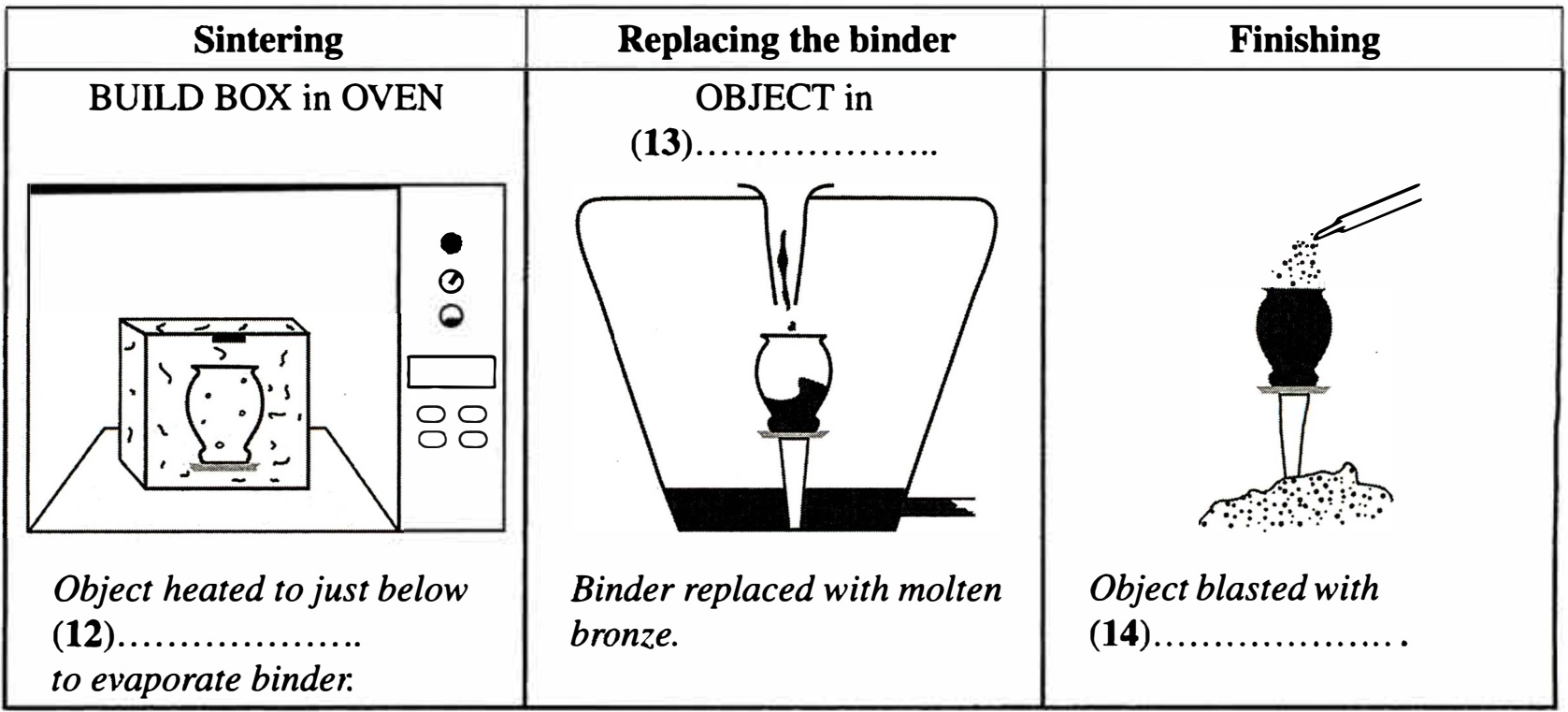
In 3D printing, an inkjet head deposits alternate layers of stainless steel powder and organic binder into a build box. After each layer of binder is spread, overhead heaters dry the object before another layer of powder is added. Upon completion of printing, the whole object, still in its build box, is sintered in an oven, which means the object is heated to just below the melting point, so the binder evaporates. Next, the porous object is placed in a furnace so that molten bronze can replace the binder. To finish, the object is blasted with tiny beads that smooth the surface.
Appraisal
In less than a century, stainless steel has become essential due to its relatively cheap production cost, its durability, and its renewability. Used in the new manufacturing process of 3D printing, its future looks bright.
Questions 1-4
Choose the correct letter A, B, C, or D.
Write the correct letter in boxes 1-4 on your answer sheet.
1 A stainless steel pot with ’18/10′ stamped on it contains
A 18% carbon and 10% iron.
B 18% iron and 10% carbon.
C 18% chromium and 10% nickel.
D 18% nickel and 10% chromium.
2 Hospitals and laboratories use stainless steel equipment because it
A is easy to clean.
B is inexpensive.
C is not disturbed by magnets.
D withstands high temperatures.
3 Stainless steel has been used in some famous buildings for its
A durability.
B beauty.
C modernity.
D reflective quality.
4 The first type of stainless steel was patented in
A China in 1912.
B Germany in 1912.
C the UK in 1919.
D the US in 1919.
Questions 5-11
Do the following statements agree with the information given in Passage 1?
In boxes 5-11 on your answer sheet, write:
TRUE if the statement agrees with the information.
FALSE if the statement contradicts the information.
NOT GIVEN if there is no information on this.
5 Stainless steel does not stain.
6 Carbon steel rusts as its surface molecules are smaller than those of iron oxide.
7 Passivation is unique to stainless steel.
8 Austenitic stainless steel is the most commonly produced type.
9 These days, Martensitic stainless steel is mainly produced in China.
10 Currently, the recycling of stainless steel takes place in many countries.
11 Close to two-thirds of a stainless steel object is made up of recycled metal.
Questions 12-14
Label the diagrams below.
Choose NO MORE THAN TWO WORDS from the passage for each answer.
Write your answers in boxes 12-14 on your answer sheet.
3D printing using stainless steel and bronze
READING PASSAGE 2
You should spend about 20 minutes on Questions 15-27 which are based on Reading Passage 2 below.
Word lists
A
As any language learner knows, the acquisition of vocabulary is of critical importance. Grammar is useful, yet communication occurs without it. Consider the utterance: ‘Me station.’ Certainly, ‘I’d like to go to the station’ is preferable, but a taxi driver will probably head to the right place with ‘Me station.’ If the passenger uses the word ‘airport’ instead of ‘station’, however, the journey may wel1 be fraught. Similarly, ‘What time train Glasgow?’ signals to a station clerk that a timetable is needed even though ‘What time does the train go to Glasgow?’ is correct. In both of these requests, nouns – ‘station’, ‘time’, ‘train’, and ‘Glasgow’ – carry most of the meaning; and, generally speaking, foreign-language learners, like infants in their mother tongue, acquire nouns first. Verbs also contain unequivocal meaning; for instance, ‘go’ indicates departure, not the arrival. Furthermore, ‘Go’ is a common word, appearing in both requests above, while ‘the’ and ‘to’ are the other frequent items. Thus, for a language learner, there may be two necessities: to acquire both useful and frequent words, including some that function grammatically. It is a daunting fact that English contains around half a million words, of which a graduate knows 25,000. So how does a language learner decide which ones to learn?
B
The General Service List (GSL), devised by the American, Michael West, in 1953, was one renowned lexical aid. Consisting of 2,000 headwords, each representing a word family, GSL words were listed alphabetically, with definitions and example sentences, while a number alongside each word showed its number of occurrences per five million words, and a percentage beside each meaning indicated how often that meaning occurred. For 50 years, particularly in the US, the GSL wielded great influence: graded readers and other materials for primary schools were written with reference to it, and American teachers of English as a foreign language (EFL) relying heavily upon it.
C
Understandably, West’s 1953 GSL has been updated several times because, firstly, his list contained archaisms such as ‘shilling’, while lacking words that existed in 1953 but which were popularized later, like ‘drug’, ‘OK’, ‘television’, and ‘victim’. Naturally, his list did not contain neologisms such as ’email’. However, around 80% of West’s original inclusions were still considered valid, according to researchers Billuroğlu and Neufeld (2005). Secondly, what constituted a headword and a word family in the West’s GSL was not entirely logical, and rules for this were formulated by Bauer and Nation (1995). Thirdly, technological advance has meant that billions of words can now be analysed by computer for frequency, context, and regional variation. West’s frequency data was based on a 2.5-million-word corpus drawn from research by Thorndike and Lorge (1944), and some of it was unreliable. A 2013 incarnation of the GSL, called the New General Service List (NGSL), used a 273-million-word subsection of the Cambridge English Corpus (CEC), and research indicates this list provides a higher degree of coverage than West’s.
D
A partner to the NGSL is the 2013 New Academic Word List (NAL) with 2,818 headwords – a modification of Averill Coxhead’s 2000 AWL. The NAWL excludes NGSL words, focusing on academic language, but, nevertheless, items in it are generally serviceable – they are merely not used often enough to appear in the NGSL. An indication of the difference between the two lists can be seen in just four words: the NGSL begins with ‘a’ and ends with ‘zonings’, whereas ‘abdominal’ and ‘yeasts’ open and close the NAWL.
E
Over time, linguistics and EF have become more dependent upon computerized statistical analysis, and large bodies of words have been collected to aid academics, teachers, and learners. One such body, known by the Latin word for body, ‘corpus’, is the CEC, created at Cambridge University in the UK. This well-known collection has two billion words of written and spoken, formal and informal, British, American, and other Englishes. Continually updated, its sources are very wide indeed – far wider than West’s. Although the CEC is one of many English-language corpora, it is not the largest, but it was the one used by the creators of the NGSL and the NAWL.
F
Still, a learner cannot easily access corpora, and even though the NGSL and NAL are free online, a learner may not know how best to use them. Linguists have demonstrated that words should be learnt in a context (not singly, not alphabetically); that items in the same lexical set should be learnt together; that it takes at least six different sightings or hearings to lea one item; that written language differs significantly from spoken; and, that concrete language is easier to acquire than abstract. Admittedly, a list of a few thousand words is not so hard to learn, but language learning is not only about frequency and utility, but also about passion and poetry. Who cares if a word you like isn’t in the top 5,000? If you like it or the way it sounds, you’re likely to lea it. And, if you use it correctly, at least your IELTS examiner will be impressed.
Questions 15-19
Passage 2 has six paragraphs: A-F.
Choose the correct heading for paragraphs B-F from the list of headings below.
Write the correct number, i-ix, in boxes 15-19 on your answer sheet.
List of Headings
i English vocabulary is hard to lea
ii Comparison of the NGSL and the NAWL
iii Description of the GSL
iv Utility and frequency should guide the choice of new lexis
v Reservations about lists and corpora
vi Learning the NAWL raises an IELTS candidate’s score
vii Reasons for overhauling the GSL
viii Benefits of the NAWL
ix Advent of corpora
Example Answer
Paragraph A iv
15 Paragraph B
16 Paragraph C
17 Paragraph D
18 Paragraph E
19 Paragraph F
Questions 20-24
Look at the following statements and the list of people on the following page.
Match each statement with the correct person or people: A-E.
Write the correct letter, A-E, in boxes 20-24 on your answer sheet.
20 He / She / They created the GSL.
21 He / She / They created the AWL.
22 He / She / They standardised headwords and word families.
23 He/ She/ They reviewed the GSL for content validity.
24 His/ Her/ Their early research was narrow.
List of people
A West
B Billuroğlu and Neufeld
C Bauer and Nation
D Thorndike and Lorge
E Coxhead
Questions 25-27
Answer the questions below.
Choose NO MORE THAN THREE WORDS AND / OR A NUMBER from the passage for each answer.
Write your answers in boxes 25-27 on your answer sheet.
25 How many words are there in the complete Cambridge English Corpus?
26 At least how many times must a learner see or hear a new word before it can be learnt?
27 According to the writer, what else must there be a sense of for a person to learn a new word?
Passage 1
1. C
2. A
3. B
4. B
5. FALSE
6. TRUE
7. FALSE
8. TRUE
9. NOT GIVEN
10. NOT GIVEN
11. TRUE
12. melting point
13. Furnace
14. tiny beads
Passage 2
15. iii
16. vii
17. ii
18. ix
19. v
20. A
21. E
22. C
23. B
24. D
25. 2/Two billion
26. 6/Six
27. Passion and poetry
Passage 3
28. C
29. E
30. B
31. A
32. Tentative
33. bodies
34. 1/one
35. culture
36. D
37. G
38. F
39. C
40. A

Bình luận