


READING PASSAGE 1
You should spend about 20 minutes on Questions 1-13 which are based on Reading Passage 1 below.
Lie Detector
A
However much we may abhor it, deception comes naturally to all living things. Birds do it by feigning injury to lead hungry predators away from nesting young. Spider crabs do it by disguise: adorning themselves with strips of kelp and other debris, they pretend to be something they are not—and so escape their enemies. Nature amply rewards successful deceivers by allowing them to survive long enough to mate and reproduce. So it may come as no surprise to learn that human beings–who, according to psychologist Gerald Jellison of the University of South California, are lied to about 200 times a day, roughly one untruth every five minutes–often deceive for exactly the same reasons: to save their own skins or to get something they can’t get by other means.
B
But knowing how to catch deceit can be just as important a survival skill as knowing how to tell a lie and get away with it. A person able to spot falsehood quickly is unlikely to be swindled by an unscrupulous business associate or hoodwinked by a devious spouse. Luckily, nature provides more than enough clues to trap dissemblers in their own tangled webs—if you know where to look. By closely observing facial expressions, body language and tone of voice, practically anyone can recognize the telltale signs of lying. Researchers are even programming computers–like those used on Lie Detector—to get at the truth by analyzing the same physical cues available to the naked eye and ear. “With the proper training, many people can learn to reliably detect lies,” says Paul Ekman, professor of psychology at the University of California, San Francisco, who has spent the past 15 years studying the secret art of deception.
C
In order to know what kind of lies work best, successful liars need to accurately assess other people’s emotional states. Ekman’s research shows that this same emotional intelligence is essential for good lie detectors, too. The emotional state to watch out for is stress, the conflict most liars feel between the truth and what they actually say and do.
D
Even high-tech lie detectors don’t detect lies as such; they merely detect the physical cues of emotions, which may or may not correspond to what the person being tested is saying. Polygraphs, for instance, measure respiration, heart rate and skin conductivity, which tend to increase when people are nervous–as they usually are when lying. Nervous people typically perspire, and the salts contained in perspiration conduct electricity. That’s why a sudden leap in skin conductivity indicates nervousness–about getting caught, perhaps? –which might, in turn, suggest that someone is being economical with the truth. On the other hand, it might also mean that the lights in the television studio are too hot–which is one reason polygraph tests are inadmissible in court. “Good lie detectors don’t rely on a single sign,” Ekman says, “but interpret clusters of verbal and nonverbal clues that suggest someone might be lying.”
E
Those clues are written all over the face. Because the musculature of the face is directly connected to the areas of the brain that process emotion, the countenance can be a window to the soul. Neurological studies even suggest that genuine emotions travel different pathways through the brain than insincere ones. If a patient paralyzed by a stroke on one side of the face, for example, is asked to smile deliberately, only the mobile side of the mouth is raised. But tell that same person a funny joke, and the patient breaks into a full and spontaneous smile. Very few people–most notably, actors and politicians–are able to consciously control all of their facial expressions. Lies can often be caught when the liar’s true feelings briefly leak through the mask of deception. “We don’t think before we feel,” Ekman says. “Expressions tend to show up on the face before we’re even conscious of experiencing an emotion.”
F
One of the most difficult facial expressions to fake—or conceal, if it is genuinely felt–is sadness. When someone is truly sad, the forehead wrinkles with grief and the inner corners of the eyebrows are pulled up. Fewer than 15% of the people Ekman tested were able to produce this eyebrow movement voluntarily. By contrast, the lowering of the eyebrows associated with an angry scowl can be replicated at will by almost everybody. “If someone claims they are sad and the inner corners of their eyebrows don’t go up,” Ekman says, “the sadness is probably false.”
G
The smile, on the other hand, is one of the easiest facial expressions to counterfeit. It takes just two muscles–the zygomaticus major muscles that extend from the cheekbones to the corners of the lips–to produce a grin. But there’s a catch. A genuine smile affects not only the corners of the lips but also the orbicularis oculi, the muscle around the eye that produces the distinctive “crow’s-feet” associated with people who laugh a lot. A counterfeit grin can be unmasked if the lip corners go up, the eyes crinkle but the inner corners of the eyebrows are not lowered, a movement controlled by the orbicularis oculi that are difficult to fake. The absence of lowered eyebrows is one reason why false smiles look so strained and stiff.
Questions 1-5
Do the following statements agree with the information given in Reading Passage 1?
In boxes 1 – 5 on your answer sheet, write
TRUE if the statement agrees with the information
FALSE if the statement contradicts the information
NOT GIVEN if the information is not given in the passage
1 All living animals can lie.
2 Some people tell lies for self-preservation.
3 The fact of lying is more important than detecting one.
4 Researchers are using equipment to study which part of the brain is responsible for telling lies.
5 To be a good liar, one has to understand other people’s emotions.
Questions 6 – 9
Choose the correct letter A, B, C or D.
Write your answer in boxes 6-9 on your answer sheet.
6 How does a lie-detector work?
A It analyzes one’s verbal response to a question.
B It records the changes in one’s facial expression.
C It illustrates the reasons about the emotional change when one is tested.
D It monitors several physical reactions in the person undergoing the test.
7 Why couldn’t lie detectors be used in a court of law?
A because the nonverbal clues are misleading.
B because there could be other causes of a certain change in the equipment.
C because the lights are too hot.
D because the statistic data on the lie detectors are not accurate.
8 The writer quotes from the paralyzed patients
A to exemplify people’s response to true feelings.
B to show the pathways for patients to recover.
C to demonstrate the paralyzed patient’s ability to smile.
D to emphasize that the patient is in a state of stroke.
9 According to the passage, politicians
A can express themselves clearly.
B are good at masking their emotions.
C are conscious of the surroundings.
D can think before action.
Questions 10 – 13
Classify the following facial traits as referring to
A Happiness
B Anger
C Sadness
Write the correct letter A, B or C in boxes 10-13 on your answer sheet.
10 Lines formed above eyebrows
11 Movement from muscle that orbits the eye
12 Eyebrows down
13 Inner corner of eyebrows raised
READING PASSAGE 2
You should spend about 20 minutes on Questions 14-26 which are based on Reading Passage 2 below.
Hunting Perfume in Madagascar!
A
Ever since the unguentari plied their trade in ancient Rome, perfumers have to keep abreast of changing fashions. These days they have several thousand ingredients to choose from when creating new scents, but there is always demand for new combinations. The bigger the ‘palette’ of smells, the better the perfumer’s chance of creating something fresh and appealing. Even with everyday products such as shampoo and soap, kitchen cleaners and washing powders, consumers are becoming increasingly fussy. And many of today’s fragrances have to survive tougher treatment than ever before, resisting the destructive power of bleach or a high temperature wash cycle. Chemists can create new smells from synthetic molecules, and a growing number of the odours on the perfumer’s palette are artificial. But nature has been in the business far longer.
B
The island of Madagascar is an evolutionary hot spot; 85% of its plants are unique, making it an ideal source for novel fragrances. Last October, Quest International, a company that develops fragrances for everything from the most delicate perfumes to cleaning products, sent an expedition to Madagascar in pursuit of some of nature’s most novel fragrances. With some simple technology, borrowed from the pollution monitoring industry, and a fair amount of ingenuity, the perfume hunters bagged 20 promising new aromas in the Madagascan rainforest. Each day the team set out from their “hotel”-a wooden hut lit by kerosene lamps, and trailed up and down paths and animal tracks, exploring the thick vegetation up to 10 meters on either side of the trail. Some smells came from obvious places, often big showy flowers within easy reach. Others were harder to pin down. “Often it was the very small flowers that were much more interesting,” says Clery. After the luxuriance of the rainforest, the little-known island of Nosy Hara was a stark, dry place-geologically and biologically very different from the mainland. “Apart from two beaches, the rest of the island is impenetrable, except by hacking through the bush,” says Clery. One of the biggest prizes here was a sweet-smelling sap weeping from the gnarled branches of some ancient shrubby trees in the parched interior. So far no one has been able to identify the plant.
C
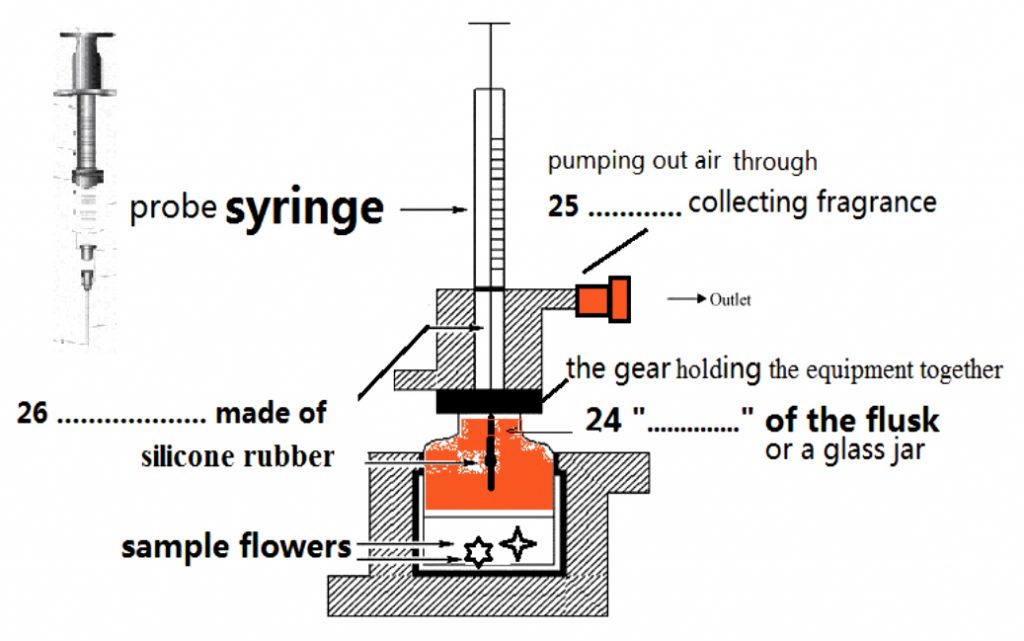
With most flowers or fruits, the hunters used a technique originally designed to trap and identify air pollutants. The technique itself is relatively simple. A glass bell jar or flask is fitted over the flower. The fragrance molecules are trapped in this ‘headspace’ and can be extracted by pumping the air out over a series of filters which absorb different types of volatile molecules. Back home in the laboratory, the molecules are flushed out of the filters and injected into a gas chromatograph for analysis. If it is impossible to attach the headspace gear, hunters fix an absorbent probe close to the source of the smell. The probe looks something like a hypodermic syringe, except that the ‘needle’ is made of silicone rubber which soaks up molecules from the air. After a few hours, the hunters retract the rubber needle and seal the tube, keeping the odour molecules inside until they can be injected into the gas chromatograph in the laboratory.
D
Some of the most promising fragrances were those given off by resins that oozed from the bark of trees. Resins are the source of many traditional perfumes, including frankincense and myrrh. The most exciting resin came from a Calophyllum tree, which produces a strongly scented medicinal oil. The sap of this Calophyllum smelt rich and aromatic, a little like church incense. But it also smelt of something like fragrance industry has learnt to live without, castoreum, a substance extracted from the musk glands of beavers and once a key ingredient in many perfumes. The company does not use animal products any longer, but it was wonderful to find a tree with an animal smell.
E
The group also set out from the island to capture the smell of coral reefs. Odors that conjure up sun kissed seas are highly sought after by the perfume industry. “ From the ocean, the only thing we have is seaweed, and that has a dark and heavy aroma. We hope to find something unique among the corals,” says Dir. The challenge for the hunters was to extract a smell from water rather than air. This was an opportunity to try Clery’s new “aquaspace” apparatus – a set of filters that work underwater. On Nosy Hara, jars were fixed over knobs of coral about 2 meters down and water pumped out over the absorbent filters. So what does coral smell like? “It’s a bit like lobster and crab,” says Clery. The team’s task now is to recreate the best of their captured smells. First they must identify the molecules that make up each fragrance. Some ingredients may be quite common chemicals. But some may be completely novel, or they may be too complex or expensive to make in the lab. The challenge then is to conjure up the fragrances with more readily available materials. “We can avoid the need to import plants from the rainforest by creating the smell with a different set of chemicals from those in the original material,” says Clery. “If we get it right, you can sniff the sample and it will transport you straight back to the moment you smelt it in the rainforest.”
Questions 14-18
The reading Passage has five paragraphs A-E
Which paragraph contains the following details?
Write the correct letter A-E in boxes 14-18 on your answer sheet.
NB You may use any letter more than once.
14 One currently preferred spot to pick up plants for novel finding
15 A new task seems to be promising yet producing limited finding in fragrance source
16 The demanding conditions for fragrance to endure.
17 A substitute for substance no longer available to the perfume manufacture
18 Description of an outdoor expedition on land chasing new fragrances.
Questions 19-23
Do the following statements agree with the information given in Reading Passage 2?
In boxes 19-23 on your answer sheet, write
TRUE if the statement is true
FALSE if the statement is false
NOT GIVEN if the information is not given in the passage
19 Manufacturers can choose to use synthetic odours for the perfume nowadays.
20 Madagascar is chosen to be a place for hunting plants which are rare in other parts of the world.
21 Capturing the smell is one of the most important things for creating new aromas.
22 The technique the hunters used to trap fragrance molecules is totally out of their ingenuity.
23 Most customers prefer the perfume made of substance extracted from the musk glands of animals.
Questions 24-26
Filling the blanks and answer the questions below with ONLY ONE WORD.
A simple device used to trap molecules
Passage 1
1. TRUE
2. TRUE
3. FALSE
4. NOT GIVEN
5. TRUE
6. D
7. B
8. A
9. B
10. C
11. A
12. B
13. C
Passage 2
14. B
15. E
16. A
17. D
18. B
19. TRUE
20. TRUE
21. NOT GIVEN
22. FALSE
23. NOT GIVEN
24. headspace
25. filters
26. needle
Passage 3
27. C
28. A
29. D
30. B
31. C
32. A
33. E
34. F
35. NO
36. NOT GIVEN
37. NO
38. YES
39. NO
40. NOT GIVEN

Bình luận