


READING PASSAGE 1
You should spend about 20 minutes on Questions 1-13 which are based on Reading Passage 1 below.
BEEN THERE; DONE THAT – IN ZERO GRAVITY
Section A
Until recently, only nation-states and their agencies were capable of sending satellites and astronauts into space. We’ve all heard of NASA, ESA, and the ISS (International Space Station), but now some private firms are challenging those institutions. The question is: are these companies merely chasing tourist dollars, or will their space exploration benefit humanity?
Section B
Currently, there are at least four big American and two British companies involved in the new space race – the mission to send tourists to the edge of Earth’s atmosphere. There they can experience the thrills of weightlessness and the marvellous sight of our planet so far away.
One such company, Blue Origin, was founded by Jeff Bezos. The billionaire Bezos was the man behind Amazon, America’s largest online retailer. The main project of Blue Origin is a vertical take-off and landing rocket, designed exclusively for tourism.
Armadillo Aerospace was also set up by a well-known American: John Carmack. He gave the world the video games Doom and Quake. Armadillo is developing a similar spacecraft to that of Blue Origin. Fares for suborbital trips will start at around $100,000. Although the spacecraft is still in the testing stage, a travel agency, Space Adventures, has signed a deal with Armadillo to sell seats.
A cheaper alternative to Armadillo’s trip may be a ride on a Lynx spacecraft. This is the brainchild of Jeff Greason, of XCOR Aerospace. This company subcontracts for NASA and is well known for producing reliable craft. Its new tourist spacecraft can take off and land on a runway at a civilian airport. It may be able to make four daily suborbital flights but will carry only one passenger each time.
Richard Branson, a British entrepreneur, is planning to start space-tourist flights on his Virgin Galactic craft. These will carry six passengers, paying up to $200,000 for their space thrill. Once thrust upwards, the craft will head for the edge of the atmosphere. The whole journey will last just a few minutes.
Starchaser, a company headed by Briton, Steve Bennet, hopes its rockets will offer a more enduring experience – a 20-minute flight, several minutes of which will be spent in zero gravity.
But probably the most impressive private space company is SpaceX. This was set up by Elon Musk, an internet entrepreneur born in South Africa. Musk made his fortune creating PayPal, which eBay bought from him for $1.5bn. While anyone else with that kind of money may well have retired, Musk works 100 hours a week at his Los Angeles rocket factory, intent on realising his dream.
Section C
For Musk, space travel is not just about ticking things off in a Lonely Planet guidebook. He believes the future of humanity lies in its ability to colonise other planets. Since his days as a student at Penn State University, he has been passionate about the future. He is certainly living on other planets is the only way humans can prevent self-destruction or save themselves from a catastrophic event like the impact of a large meteorite.
Musk established SpaceX in 2002. Yet within only seven years, it had launched a satellite from its rocket, Falcon 1. By contrast, agencies like NASA and ESA take decades to achieve similar feats. In 2010, SpaceX sent its much larger Falcon 9 rocket into space. The next venture is to provide a taxi service to the ISS with Dragon, a small shuttle that Falcon 9 launches. This will deliver cargo and astronauts to the station. Dragon is radically different in design from the existing Shuttle, and far less costly.
Section D
In fact, before building Falcon and Dragon, Musk thoroughly researched the costs of building and launching rockets. He could not understand why government agencies spent so much money on these activities, and he concluded, quite simply, that they were inefficient. To prove his theory, SpaceX has produced the Merlin engine, which is elegantly designed, extremely powerful, and relatively cheap. It runs on highly refined kerosene that costs half the price of other rocket fuel. In most of SpaceX’s spacecraft, parts are re-usable, an innovation in the industry. There are also fewer stages in rocket transformation. That is: there are fewer times a rocket separates into smaller parts. All of this means spacecraft can be produced at a fraction of the cost of competitors while maintaining the same high safety standards.
Section E
Musk maintains that the Falcon 9, a rocket that carries astronauts, is so powerful it could already reach Mars if it were assembled in Earth’s orbit. He believes this technological advance will occur within 20 years – something most experts consider unlikely. Moreover, he firmly believes living on Mars is possible within the lifetime of his children. For him, the new space race is not only about selling tickets for a mind-blowing ride, but also about securing the future of our species.
For other private companies, however, there is no urge to invest heavily in missions to distant planets. Making a profit at the high end of the tourist market here on Earth is their only goal.
Questions 1-4
Reading Passage 1 has five sections: A-E.
Choose the correct heading for sections B-E from the list of headings below.
Write the correct number, i-vii, in boxes 1-4 on your answer sheet.
List of Headings
i To colonise or generate revenue?
ii The big six
iii NASA spends too much
iv It’s not rocket science
v Public or private spacecraft?
vi Why Americans dominate
vii An idealist and a realist
Example Answer
Section A v
1 Section B
2 Section C
3 Section D
4 Section E
Questions 5-9
Choose NO MORE THAN TWO WORDS AND / OR A NUMBER from the passage for each
answer.
Write your answers in boxes 5-9 on your answer sheet.
5 A ticket on one of Armadillo Aerospace’s trips into space is likely to cost …………………… .
6 A single passenger will journey on a(n) ………………….. spacecraft.
7 A ride on Virgin Galactic will take only …………………… minutes.
8 On a Starchaser spacecraft, a passenger will experience ……………………… minutes of weightlessness.
9 Elon Musk sold ………………….. , and set up SpaceX, which builds rockets.
Questions 10-13
Do the following statements agree with the information in Reading Passage 1?
In boxes 23-27 on your answer sheet, write:
TRUE if the statement agrees with the information
FALSE if the statement contradicts the information
NOT GIVEN if there is no information on this
10 Musk is a keen supporter of human settlement in space.
11 Overall, SpaceX’s rockets are faster than its competitors.
12 Musk believes a manned spacecraft will reach Mars within 20 years.
13 Most private space companies share Musk’s enthusiasm for distant space travel.
READING PASSAGE 2
You should spend about 20 minutes on Questions 14-26 which are based on Reading Passage 2 below.
BRAND LOYALTY RUNS DEEP
At almost any supermarket in Sydney, Australia, food from all over the world fills the shelves. Perhaps you fancy some Tick Tock Rooibos tea made in South Africa, or some Maharaja’s Choice Rogan Josh sauce from India. Alongside local Foster’s beer, Chinese Tsingtao and Indonesian Bintang are both to be found. For homesick Britons, the confectionary aisle is stocked with Mars Bars and Bountys, while for pining Poles sweets manufactured by firms like Wawel or Solidarposc are available. Restaurants in Sydney range from Afghan to Zambian, catering for different ethnic groups as well as the rest of the curious general public.
All of this variety is a result of population movement and changes in global trade, and, to a lesser extent, reduced production and transportation costs. While Australia can claim around 40% of its population as the first generation, other countries, like Switzerland, may have fewer international migrants, but still, have people who move from city to city in search of work. Even since the 1990s, taxes or tariffs on imported goods have decreased dramatically. The World Trade Organisation, for example, has promulgated the idea of zero tariffs, which has been adopted into legislation by many member states. It is estimated that within a century, agriculture worldwide has increased its efficiency five-fold. Faster and better-integrated road and rail services, containerisation, and the ubiquitous aeroplane have sped up transport immeasurably.
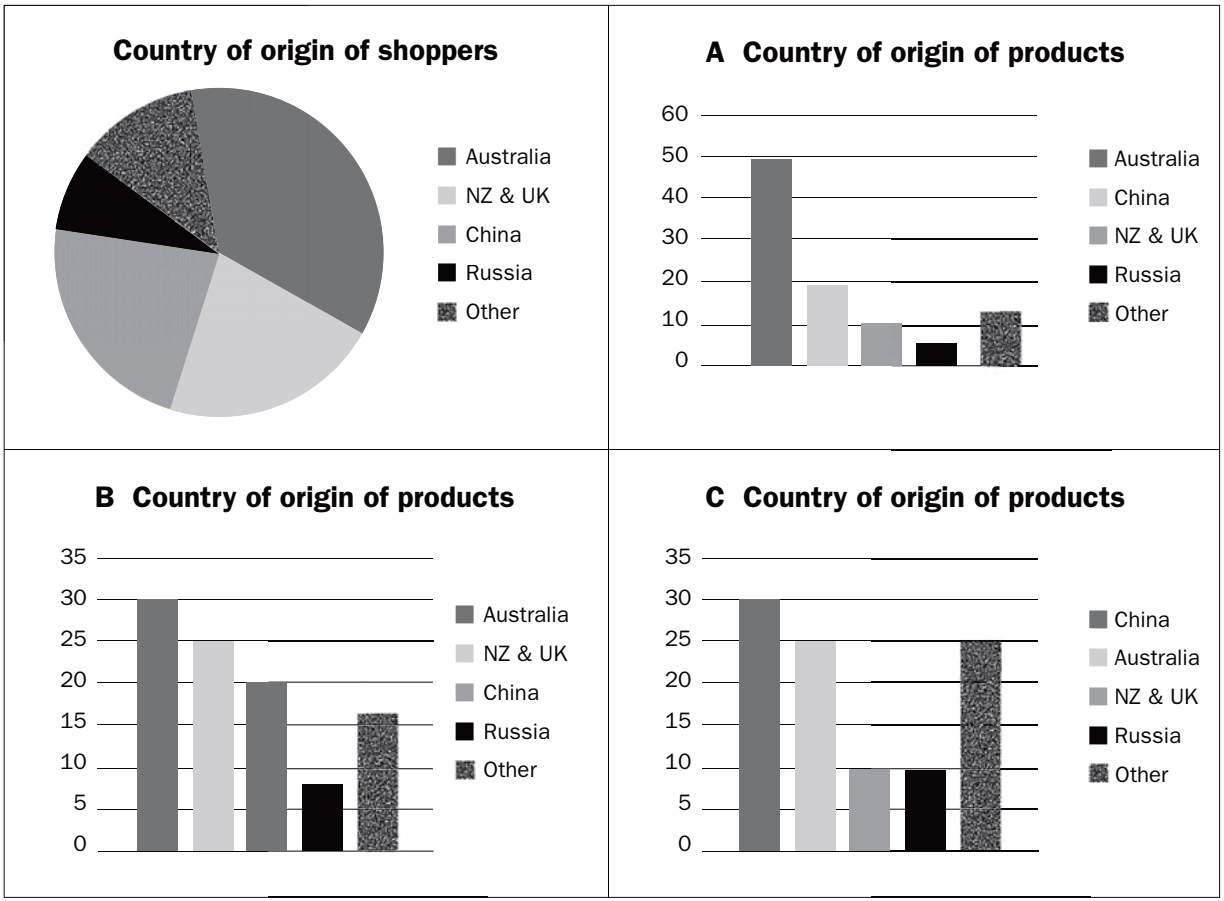
Even with this rise in the availability of non-local products, recent studies suggest that supermarkets should do more to increase their number to match more closely the proportion of shoppers from those countries or regions. Thus, if 10% of a supermarket’s customers originate in Vietnam, there ought to be 10% Vietnamese products in store. If Americans from southern states dominate in one northern neighbourhood, southern brands should also be conspicuous. Admittedly, there are already specialist shops that cater to minority groups, but minorities do frequent supermarkets.
Two separate studies by Americans Bart Bronnenberg and David Atkin have found that brand loyalty (choosing Maharaja’s Choice over Patak’s, or Cadbury’s over Nestlé) is not only determined by advertising, but also by a consumer’s past. If a product featured in a person’s early life in one place, then, as a migrant, he or she is likely to buy that same product even though it is more expensive than an otherwise identical locally-produced one.
In the US context, between 2006 and 2008, Bronnenberg analysed data from 38,000 families who had bought 238 different kinds of packaged goods. Although the same brands could be found across America, there were clear differences in what people purchased. In general, there were two leading brands in each kind of packaged good, but there were smaller brands that assumed a greater proportion of consumers’ purchases than was statistically likely. One explanation for this is that 16% of people surveyed came from interstate, and these people preferred products from their home states. Over time, they did buy more products from their adopted state, but, surprisingly, it took two decades for their brand loyalty to halve. Even people who had moved interstate 50 years previously maintained a preference for home-state brands. It seems the habits of food buying change more slowly than we think.
Bronnenberg’s findings were confirmed by Atkin’s in India although there was something more unexpected that Atkin discovered. Firstly, during the period of his survey, the cost of all consumables rose considerably in India. As a result, families reduced their spending on food, and their calorific intake fell accordingly. It is also worth noting that although India is one country, states impose tariffs or taxes on products from other Indian states, ensuring that locally-produced goods remain cheaper. As in the US, internal migrants bought food from their native place even when it was considerably more expensive than local alternatives, and at a time when you might expect families to be economising. This element made the brand-loyalty theory even more convincing.
There is one downside to these findings. In relatively closed economies, such as India’s, people develop tastes that they take with them wherever they go; in a more globalised economy, such as America’s, what people eat may be more varied, but still dependent on early exposure to brands. Therefore, according to both researchers, more advertising may now be directed at minors since brand loyalty is established in childhood and lasts a lifetime. In a media-driven world where children are already bombarded with information, their parents may not consider appropriate yet more advertising is hardly welcome.
For supermarkets, this means that wherever there are large communities of expatriates or immigrants, it is essential to calculate the demographics carefully in order to supply those shoppers with their favourite brands as in light of Atkin and Bronnenberg’s research, advertising and price are not the sole motivating factors for purchase as was previously thought.
Questions 14-18
Choose the correct letter: A, B, C, or D.
Write the correct letter in boxes 14-18 on your answer sheet.
14 In this article, the writer refers to food products that are sold
A at markets.
B wholesale.
C online.
D retail.
15 In Sydney, shoppers can buy beer from
A China and Indonesia.
B India and South Africa.
C Poland.
D Vietnam.
16 The greater variety of goods and brands now available is mainly due to:
A cheaper production and more migration.
B changes in migration and international trade.
C cheaper production and transport.
D changes in migration and transport.
17 The writer thinks supermarkets ………… should change their products slightly.
A in Australia
B in India and the US
C in Switzerland
D worldwide
18 The writer suggests that:
A the quality of products at specialist shops will always be better than at supermarkets.
B specialist shops will close down because supermarkets will be cheaper.
C specialist shops already supply minority groups, so supermarkets shouldn’t bother.
D specialist shops already supply minority groups, yet supermarkets should compete with them.
Question 19
Which chart below – A, B, or C – best describes the relationship between shoppers at one Sydney supermarket, and what research suggests that same supermarket should sell?
Write your answer in box 19 on your answer sheet.
Questions 20-26
Which study/studies do the following statements relate to?
In boxes 20-26 on your answer sheet, write:
A if the information relates only to Atkin’s study
B if the information relates only to Bronnenberg’s study
C if the information relates to both Atkin’s and Bronnenberg’s studies
20 There was a correlation between brands a shopper used in childhood, and his or her
preferences as an adult.
21 One reason for the popularity of smaller brands was that many people surveyed came
from another state where those brands were bigger.
22 Even living in a new state for a very long time did not mean that shoppers chose new
brands.
23 In general, food became more expensive during the time of the study. Despite this,
families bought favourite brands and ate less.
24 Taxes on products from other states also increased the cost of food. This did not stop
migrants from buying what they were used to.
25 Children may be the target of more food advertising now.
26 Advertising and price were once thought to be the main reasons for buying products. This
theory has been modified now.
Passage 1
1. ii
2. vii
3. iv
4. i
5. around $100,000 (dollar sign necessary)
6. Lynx (capital optional)
7. a few (‘a’ necessary)
8. several
9. PayPal (capitals optional)
10. TRUE
11. NOT GIVEN
12. TRUE
13. FALSE
Passage 2
14. D
15. A
16. B
17. D
18. D
19. B
20. C
21. C
22. B
23. A
24. A
25. C
26. C
Passage 3
27. D
28. A
29. F
30. G
31. New Zealand (capitals optional)
32. climate change/ environmental pressures
33. young
34. bones/skeletons
35. D
36. A
37. C
38. B
39. B
40. E

Bình luận