


READING PASSAGE 1
You should spend about 20 minutes on Questions 1-13 which are based on Reading Passage 1 below.
T-Rex Hunter
A
Jack Horner is an unlikely academic: his dyslexia is so bad that he has trouble reading a book. But he can read the imprint of life in sandstone or muddy shale across a distance of 100m years, and it is this gift that has made him curator of palaeontology at Montana State University’s Museum of the Rockies, the leader of a multi-million dollar scientific project to expose a complete slice of life 68m years ago, and a consultant to Steven Spielberg and other Hollywood figures.
B
Ads by Ad.Plus
His father had a sand and gravel quarry in Montana, and the young Horner was a collector of stones and bones, complete with notes about when and where he found them. “My father had owned a ranch when he was younger, in Montana,” he says. “He was enough of a geologist, is a sand and gravel man, to have a pretty good notion that they were dinosaur bones. So when I was eight years old he took me back to the area that had been his ranch, to where he had seen these big old bones. I picked up one. I am pretty sure it was the upper arm bone of a duckbilled dinosaur: it probably wasn’t a maiaosaur but closely related to that. I catalogued it, and took good care of it, and then later when I was in high school, excavated my first dinosaur skeleton. It obviously started earlier than eight and I literally have been driven ever since. I feel like I was born this way.”
C
Horner spent seven years at university but never graduated. “I have a learning disability, I would call it a learning difference – dyslexia, they call it – and I just had a terrible time with English and foreign languages and things like that. For a degree in geology or biology, they required two years of a foreign language. There was no way in the world I could do that. In fact, I didn’t really pass English. So I couldn’t get a degree, I just wasn’t capable of it. But I took all of the courses required and I wrote a thesis and I did all sorts of things. So I have the education, I just don’t have the piece of paper,” he says.
D
In Montana, in those days, everybody had the right to a college education. His grades at high school had been terrible, at university, his advisers recognised that he was having a hard time, and went on helping. The dean who kept readmitting him was to give Horner an honorary doctorate years later. As a young non-graduate, Horner wrote to every museum in the English-speaking world, asking for a job. Los Angeles County Museum and the Royal Ontario Museum in Toronto made offers, but he accepted a post as a technician at Princeton University because of Princeton, New Jersey.
E
“We definitely know we are working on a very broad coastal plain with the streams and rivers bordered by conifers and hardwood plants, and the areas in between these rivers were probably fern-covered. There were no grasses at all: just ferns and bushes – an unusual landscape, kind of taking the south-eastern United States – Georgia, Florida – and mixing it with the moors of England and flattening it out,” he says. “Triceratops is very common: they are the cows of the Cretaceous, they are everywhere. Duckbilled dinosaurs are relatively common but not as common as triceratops and T rex, for a meat-eating dinosaur, is very common. What we would consider the predator-prey ratio seems really off the scale. What is interesting is the little dromaeosaurs, the ones we know for sure were good predators, we haven’t found any of them.”
F
Which is why he sees T rex, not as the lion of the Cretaceous savannah but its vulture. “Look at the wildebeest that migrate in the Serengeti of Africa, a million individuals lose about 200,000 individuals in that annual migration. There is a tremendous carrion base there. And so you have hyenas, you have tremendous numbers of vultures that are scavenging, you don’t have all that many animals that are good predators. If T rex was a top predator, especially considering how big it is, you’d expect it to be extremely rare, much rarer than the little dromaeosaurs, and yet they are everywhere, they are a dime a dozen,” he says. A 12-tonne T rex is a lot of vultures, but he doesn’t see the monster as clumsy. He insisted his theory and finding, dedicated to further research upon it, of course, he would like to reevaluate if there is any case that additional evidence found or explanation raised by others in the future.
G
He examined the leg bones of the T-rex, and compared the length of the thigh bone (upper leg), to the shin bone (lower leg). He found that the thigh bone was equal in length or slightly longer than the shin bone, and much thicker and heavier. Which proves that the animal was built to be a slow walker rather than fast running. On the other hand, the fossils of fast hunting dinosaurs ALWAYS showed that the shin bone was longer than the thigh bone. This same truth can be observed in many animals of today which are designed to run fast: The ostrich, cheetah, etc.
H
He also studied the fossil teeth of the T-rex, and compared them with the teeth of the Velociraptor, and put the nail in the coffin of the “hunter T-rex theory”. The Velociraptor’s teeth were like steak knives: sharp, razor-edged, and capable of tearing through flesh with ease. The T-Rex’s teeth were huge, sharp at their tip, but blunt, propelled by enormous jaw muscles, which enabled them to only crush bones.
I
With the evidence presented in his documentary, Horner was able to prove that the idea of the T-rex as being a hunting and ruthless killing machine is probably just a myth. In light of the scientific clues he was able to unearth, the T-rex was a slow, sluggish animal which had poor vision, an extraordinary sense of smell, that often reached its “prey” after the real hunters were done feeding, and sometimes it had to scare the hunters away from a corpse. In order to do that, the T-rex had to have been ugly, nasty-looking, and stinky. This is actually true of nearly all scavenger animal. They are usually vile and nasty looking.
Questions 1-7
Do the following statements agree with the information given in Reading Passage 1?
In boxes 1-7 on your answer sheet, write
TRUE if the statement is true
FALSE if the statement is false
NOT GIVEN if the information is not given in the passage
1 Jack Horner knew exactly the bone belonged to a certain dinosaur when he was in father’s ranch at the age of 8.
2 Jack Horner achieved a distinctive degree in university when he graduated.
3 Jack Horner is the first man that discovered T-Rex’s bone in the world.
4 Jack Horner believes that the number of prey should be more than that of the predator.
5 T-rex’s number is equivalent to the number of vulture in the Serengeti.
6 The hypothesis that T-rex is top predator conflicts with the fact of the predator-prey ratio which Jack found.
7 He refused to accept any other viewpoints about T-rex’s category.
Questions 8-13
Complete the following summary of the paragraphs of Reading Passage.
Using NO MORE THAN TWO WORDS from the Reading Passage for each answer.
Write your answers in boxes 8-13 on your answer sheet.
Jack Horner found that T-rex’s 8…………………………. is shorter than the thigh bone, which demonstrated that it was actually a 9…………………………., unlike other swift animals such as ostrich or 10………………………… that was built to 11…………………….. Another explanation supports his idea is that T-rex’s teeth were rather 12……………………….., which only allowed T-rex to 13…………………….. hard bones instead of tearing flesh like Velociraptor.
READING PASSAGE 2
You should spend about 20 minutes on Questions 14-27 which are based on Reading Passage 2 below.
Detection of a meteorite Lake
A
As the sun rose over picturesque Lake Bosumtwi, a team of Syracuse University researchers prepared for another day of using state-of-the-art equipment to help bottom. Nestled in the heart of Ghana, the lake holds an untapped reservoir of information that could help scientists predict future climate changes by looking at evidence from the past. This information will also improve the scientists’ understanding of the changes that occur in a region struck by a massive meteorite.
B
The project, led by earth sciences professor Christopher Scholz of the College of Arts and Sciences and funded by the National Science Foundation (NSF), is the first large-scale effort to study Lake Bosumtwi, which formed 1.1 million years ago when a giant meteor crashed into the Earth’s surface. The resulting crater is one of the largest and most well-preserved geologically young craters in the world, says Scholz, who is collaborating on the project with researchers from the University of Arizona, the University of South Carolina, the University of Rhode Island, and several Ghanaian institutions. “Our data should provide information about what happens when an impact hits hard, pre-Cambrian, crystalline rocks that are a billion years old,” he says.
C
Equally important is the fact that the lake, which is about 8 kilometers in diameter, has no natural outlet. The rim of the crater rises about 250 meters above the water’s surface. Streams flow into the lake, Scholz says, but the water leaves only by evaporation, or by seeping through the lake sediments. For the past million years, the lake has acted as a tropical rain gauge, filling and drying with changes in precipitation and the tropical climate. The record of those changes is hidden in the sediment below the lake bottom. “The lake is one of the best sites in the world for the study of tropical climate changes,” Scholz says. “The tropics are the heat engine for the Earth’s climate. To understand the global climate, we need to have records of climate changes from many sites around the world, including the tropics.”
D
Before the researchers could explore the lake’s subsurface, they needed a boat with a large, working deck area that could carry eight tons of scientific equipment. The boat – dubbed R/V Kilindi – was built in Florida last year. It was constructed in modules that were dismantled, packed inside a shipping container, and reassembled over a 10-day period in late November and early December 1999 in the rural village of Abono, Ghana. The research team then spent the next two weeks testing the boat and equipment before returning to the United States for the holidays.
E
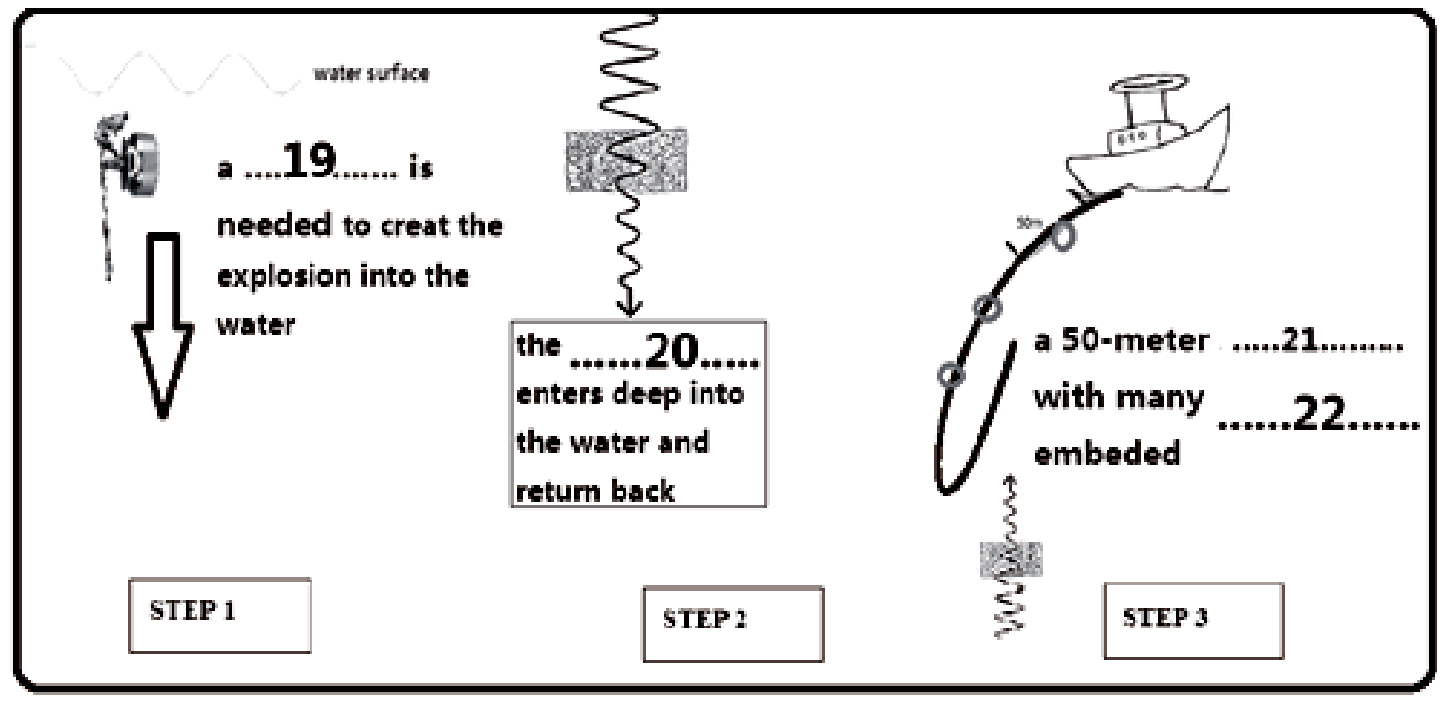
In mid-January, five members of the team – Keely Brooks, an earth sciences graduate student; Peter Cattaneo, a research analyst; and Kiram Lezzar, a postdoctoral scholar, all from SU; James McGill, a geophysical field engineer; and Nick Peters, a Ph.D. student in geophysics from the University of Miami – returned to Abono to begin collecting data about the lake’s subsurface using a technique called seismic reflection profiling. In this process, a high-pressure air gun is used to create small, pneumatic explosions in the water. The sound energy penetrates about 1,000 to 2,000 meters into the lake’s subsurface before bouncing back to the surface of the water.
F
The reflected sound energy is detected by underwater microphones – called hydrophones – embedded in a 50-meter-long cable that is towed behind the boat as it crosses the lake in a carefully designed grid pattern. On-board computers record the signals, and the resulting data are then processed and analyzed in the laboratory. “The results will give us a good idea of the shape of the basin, how thick the layers of sediment are, and when and where there were major changes in sediment accumulation,” Scholz says. “We are now developing a three-dimensional perspective of the lake’s subsurface and the layers of sediment that have been laid down.”
G
Team members spent about four weeks in Ghana collecting the data. They worked seven days a week, arriving at the lake just after sunrise. On a good day, when everything went as planned, the team could collect data and be back at the dock by early afternoon. Except for a few relatively minor adjustments, the equipment and the boat worked well. Problems that arose were primarily non-scientific – tree stumps, fishing nets, cultural barriers, and occasional misunderstandings with local villagers.
H
Lake Bosumtwi, the largest natural freshwater lake in the country, is sacred to the Ashanti people, who believe their souls come to the lake to bid farewell to their god. The lake is also the primary source of fish for the 26 surrounding villages. Conventional canoes and boats are forbidden. Fishermen travel on the lake by floating on traditional planks they propel with small paddles. Before the research project could begin, Scholz and his Ghanaian counterparts had to secure special permission from tribal chiefs to put the R/V Kilindi on the lake.
I
When the team began gathering data, rumors flew around the lake as to why the researchers were there. “Some thought we were dredging the lake for gold, others thought we were going to drain the lake or that we had bought the lake,” Cattaneo says. “But once the local people understood why we were there, they were very helpful.”
Questions 14-18
Do the following statements agree with the information given in Reading Passage 2?
In boxes 23-26 on your answer sheet, write
TRUE if the statement is true
FALSE if the statement is false
NOT GIVEN if the information is not given in the passage
14 With the investigation of the lake, the scientist may predict the climate changes in the future.
15 The crater resulted from a meteorite impact is the largest and most preserved one in the world.
16 The water stored in lake Bosumtwi was gone only by seeping through the lake sediments.
17 Historical climate changes can be detected by the analysis of the sediment in the lake.
18 The greatest obstacle to the research of scientists had been the interference by the locals due to their indigenous believes.
Questions 19-22
There are three steps of collecting data from the lake as followings, please fill the blanks in the Flow Chart below:
Questions 23-27
Complete the following summary of the paragraph of Reading Passage.
Using NO MORE THAN THREE WORDS from the Reading Passage for each answer.
Write your answers in boxes 23-27 on your answer sheet.
The boat-double R/V Kilindi crossed the lake was dismantled and stored in a 23………………………. The technology they used called 24………………………; They created sound energy into 1000-2000 metres into the bottom of the lake and used separate equipment to collect the returned waves. Then the data had been analyzed and processed in the 25……………………… Scholz also added that they were now building 26……………………. View of the sediment or sub-image in the bottom of the lake. The whole set of equipment works well yet the ship should avoid physical barrier including tree stumps or 27………………………. Floating on the surface of the lake.
Passage 1
1. TRUE
2. FALSE
3. NOT GIVEN
4. TRUE
5. NOT GIVEN
6. TRUE
7. FALSE
8. shin bone
9. slow walker
10. cheetah
11. run fast
12. blunt
13. crush
Passage 2
14. TRUE
15. NOT GIVEN
16. FALSE
17. TRUE
18. FALSE
19. (high-pressure) air gun
20. sound energy/ sound wave
21. cable
22. hydrophones/ underwater microphones
23. shipping container
24. seismic reflection profiling
25. laboratory
26. three-dimensional
27. fishing nets
Passage 3
28. hammer
29. body
30. pad
31. cavities/ sinus cavities
32. trunks and feet
33. infrasonic
34. ecology
35. seismic messages
36. acoustic communication/ communications
37. mate
38. ground
39. A
40. C

Bình luận