


READING PASSAGE 1
You should spend about 20 minutes on Questions 1-13 which are based on Reading Passage 1 below.
History of timekeeping
Ever since man first noticed the regular movement of the Sun and the stars, we have wondered about the passage of time. Prehistoric people first recorded the phases of the Moon some 30,000 years ago, and recording time has been a way by which humanity has observed the heavens and represented the progress of civilization.
The earliest natural events to be recognized were in the heavens, but during the course of the year, there were many other events that indicated significant changes in the environment. Seasonal winds and rains, the flooding of rivers, the flowering of trees and plants, and the breeding cycles or migration of animals and birds, all led to natural divisions of the year, and further observation and local customs led to the recognition of the seasons.
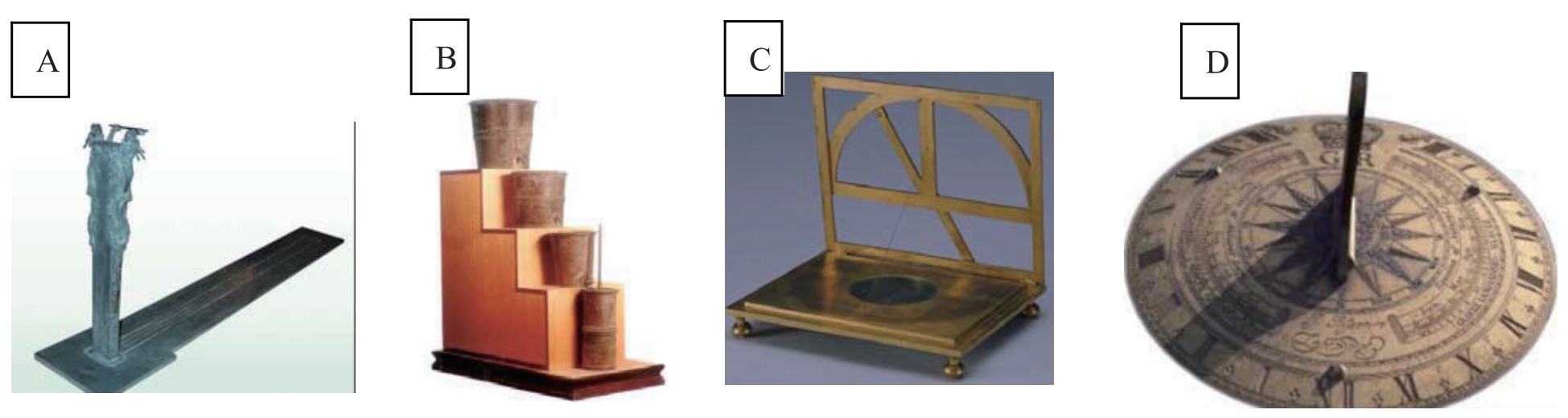
Egyptian shadow clocks divided daytime into 12 parts with each part further divided into more precise parts. One type of shadow clock consisted of a long stem with five variable marks and an elevated crossbar which cast a shadow over those marks. It was positioned eastward in the morning and was turned west at noon. Obelisks functioned in much the same manner: the shadow cast on the markers around it allowed the Egyptians to calculate the time. The obelisk also indicated whether it was morning or afternoon, as well as the summer and winter solstices. 1500 BCE, was similar in shape to a bent T-square. It measured the passage of time by the shadow cast by its crossbar on a non-linear rule. The T was oriented eastward in the mornings and turned around at noon so that it could cast its shadow in the opposite direction. Although accurate, shadow clocks relied on the sun, and so were useless at night and in cloudy weather.
Inventions for measuring and regulating time
The early inventions were made to divide the day or the night into different periods in order to regulate work or ritual, so the lengths of the time periods varied greatly from place to place and from one culture to another.
Oil lamps
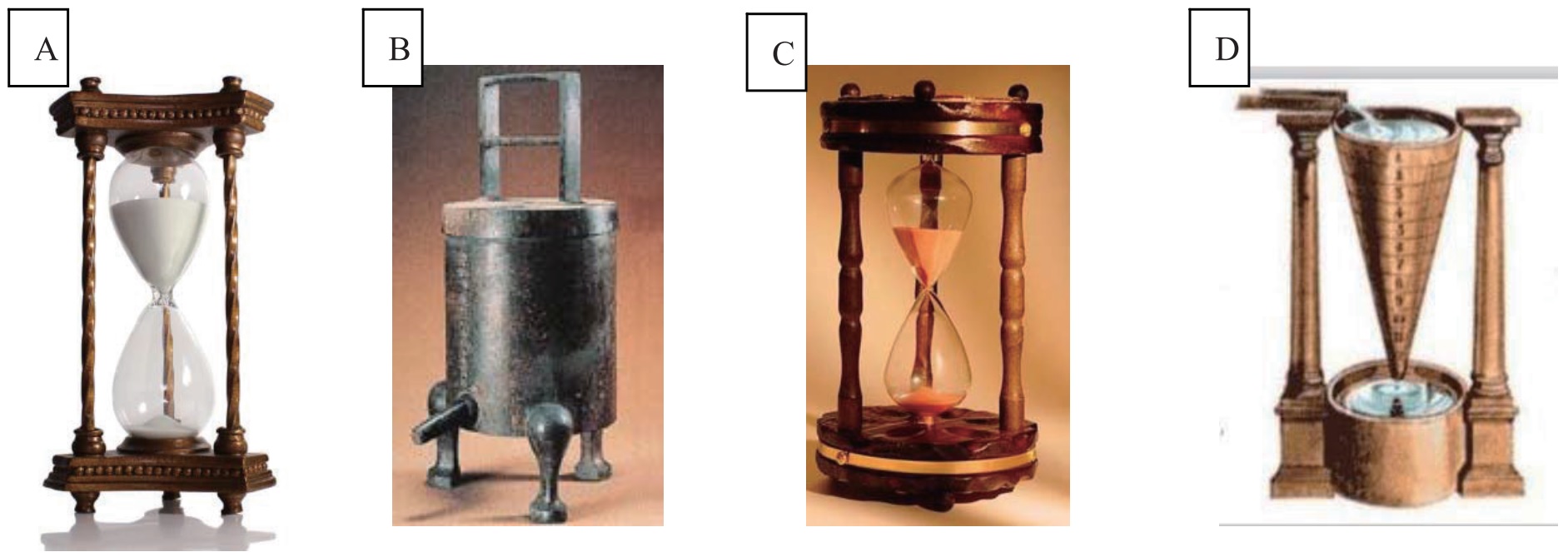
There is archaeological evidence of oil lamps about 4,000 BCE, and the Chinese were using oil for heating and lighting by 2,000 BCE. Oil lamps are still significant in religious practices, symbolic of the journey from darkness and ignorance to light and knowledge. The shape of the lamp gradually evolved into the typical pottery style shown. It was possible to devise a way of measuring the level in the oil reservoir to measure the passing of time.
Candle Clocks
Marked candles were used for telling the time in China from the sixth century CE. There is a popular story that King Alfred the Great invented the candle clock, but we know they were in use in England from the tenth century CE. However, the rate of burning is subject to draughts, and the variable quality of the wax. Life oil lamps, candles were used to mark the passage of time from one event to another, rather than tell the time of day.
Water Clocks
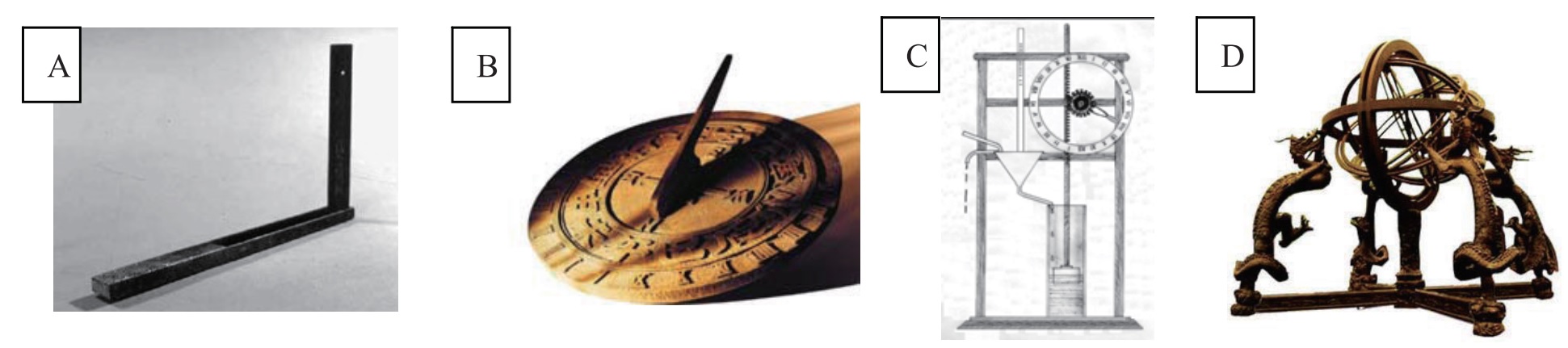
The water clock, or clepsydra, appears to have been invented about 1,500 BCE and was a device which relied on the steady flow of water from or into a container. Measurements could be marked on the container or on a receptacle for the water. In comparison with the candle or the oil lamp, the clepsydra was more reliable, but the water flow still depended on the variation of pressure from the head of water in the container.
Astronomical and astrological clock making was developed in China from 200 to 1300 CE. Early Chinese clepsydras drove various mechanisms illustrating astronomical phenomena. The astronomer Su Sung and his associates built an elaborate clepsydra in 1088 CE. This device incorporated a water-driven bucket system originally invented about 725 CE. Among the displays were a bronze power-driven rotating celestial globe, and manikins that rang gongs, and indicated special times of the day.
Hour Glasses or Sandglasses
As the technology of glass-blowing developed, from some time in the 14th century it became possible to make sandglasses. Originally, sandglasses were used as a measure for periods of time like the lamps or candles, but as clocks became more accurate they were used to calibrate sandglasses to measure specific periods of time, and to determine the duration of sermons, university lectures, and even periods of torture.
The Division of the Day and the Length of the ‘Hour’ An Egyptian sundial from about 1,500 BCE is the earliest evidence of the division of the day into equal parts, but the sundial was no use at night. The passage of time was extremely important for astronomers and priests who were responsible for determining the exact hour for the daily rituals and for the important religious festivals, so a water clock was invented.
The Merkhet
The Egyptians improved upon the sundial with a ‘merkhet’, one of the oldest known astronomical instruments. It was developed around 600 BCE and uses a string with a weight as a plumb line to obtain a true vertical line, as in the picture. The other object is the rib of a palm leaf, stripped of its fronds and split at one end, making a thin slit for a sight.
A pair of merkhets were used to establish a North-South direction by lining them up one behind the other with the Pole Star. Viewing the plumb lines through the sight made sure the two merkhets and the sight were in the same straight line with the Pole Star. This allowed for the measurement of night-time events with a water clock when certain stars crossed the vertical plumb line (a ‘transit line’), and these events could then be recorded by ‘night-time lines’ drawn on a sundial.
There are various theories about how the 24 hour day developed. The fact that the day was divided into 12 hours might be because 12 is a factor of 60, and both the Babylonian and Egyptian civilisations recognised a zodiac cycle of 12 constellations. On the other hand, (excuse the pun) finger-counting with base 12 was a possibility. The fingers each have 3 joints, and so counting on the joints gives one ‘full hand’ of 12.
In classical Greek and Roman times they used twelve hours from sunrise to sunset; but since summer days and winter nights are longer than winter days and summer nights, the lengths of the hours varied throughout the year.
Questions 1-4
Do the following statements agree with the information given in Reading Passage 1?
In boxes 1-4 on your answer sheet, write
YES if the statement is true
NO if the statement is false
NOT GIVEN if the information is not given in the passage
1 Timekeeper’s exact date of origin was not clear today.
2 People use candles and oil lamps for recording time to do things in the early days.
3 Oil lamps are used for religious beliefs in 4000 BCE.
4 The sundials have always been inaccurate to record time in ancient Egypt.
Questions 5-10
Write the correct letter A-D, in boxes 5-10 on your answer sheet
NB You may use any letter more than once.
A Wooden shadow clock
B Clepsydra
C Sandglasses
D lamp oil candle
5 It is used the container tag position recording time
6 It is used to measure a particular time
7 It is used only in the sunny day
8 It is used oil cistern to measure the passage of time
9 It isn’t only used to tell the time
10 It is more accurate than candles and oil lamps
Questions 11-13
Choose the correct letter, A, B, C or D.
Write your answers in boxes 11-13 on your answer.
11 Which picture shows the working principle of clepsydra?
12 Which picture best describes the wooden shadow?
13 The picture below illustrates the oil lamp clock’s working
READING PASSAGE 2
You should spend about 20 minutes on Questions 14-26 which are based on Reading Passage 2 below.
Water Treatment 2: Reed Bed
A
Nowadays subsurface flow wetlands are a common alternative in Europe for the treatment of wastewater in rural areas. mainly in the last 10 to 12 years, there has been significant growth in the number and size of the systems in use. Compared to common treatment facilities, wetlands lower in cost investment, lesser to maintain, and are ideal for densely populated rural or suburban areas rather than urban areas.
B
The Common Read has the ability to transfer oxygen from its leaves, down through its stem and rhizomes and out via its root system. As a result of this action, a very high population of micro-organisms occurs in the root system, with zones of aerobic, anoxic, and anaerobic conditions. Therefore with the waste water moving very slowly and carefully through the mass of Reed roots, this liquid can be successfully treated.
C
A straightforward definition of a reed bed is if you have dirty water in your pool or water, which is heavily polluted, Read Beds will be planted to make the water clean again. This is good for ecology and living organisms and fish in the water. Reed Beds have a wide range of qualities and are acceptable for cleaning everything from secondary to tertiary treatment of mild domestic effluent, to rural waste and even heavy industrial contaminants. The reason why they’re so effective is often that within the bed’s root sector, natural biological, physical and chemical processes interact with one another to degrade or remove a good range of pollutants. Reed beds can be built in a number of variants, but mainly they are of the horizontal flow or vertical (down) flow configuration where water flows through the beds horizontally or vertically.
HORIZONTAL FLOW REED BED SYSTEMS
D
Horizontal-flow wetlands may be of two types: free-water surface-flow (FWF) or subsurface water-flow (SSF). In the former, the effluent flows freely above the sand/gravel bed in which the reeds etc. are planted; in the latter effluent passes through the sand/ gravel bed. In FWF-type wetlands, the effluent is treated by plant stems, leaves and rhizomes. Such FWF wetlands are densely planted and typically have water-depths of less than 0.4m. However, dense planting can limit oxygen diffusion into the water. These systems work particularly well for low strength effluents or effluents that have undergone some form of pretreatment and play an invaluable role in tertiary treatment and the polishing of effluents. The horizontal reed flow system uses a long reed bed, Where the liquid slowly flows horizontally through. The length of the reed bed is about 100 meters. The downside of the horizontal reed beds is that they use up lots of land space and they do take quite a long time to produce clean water.
VERTICAL FLOW REED BED SYSTEMS
E
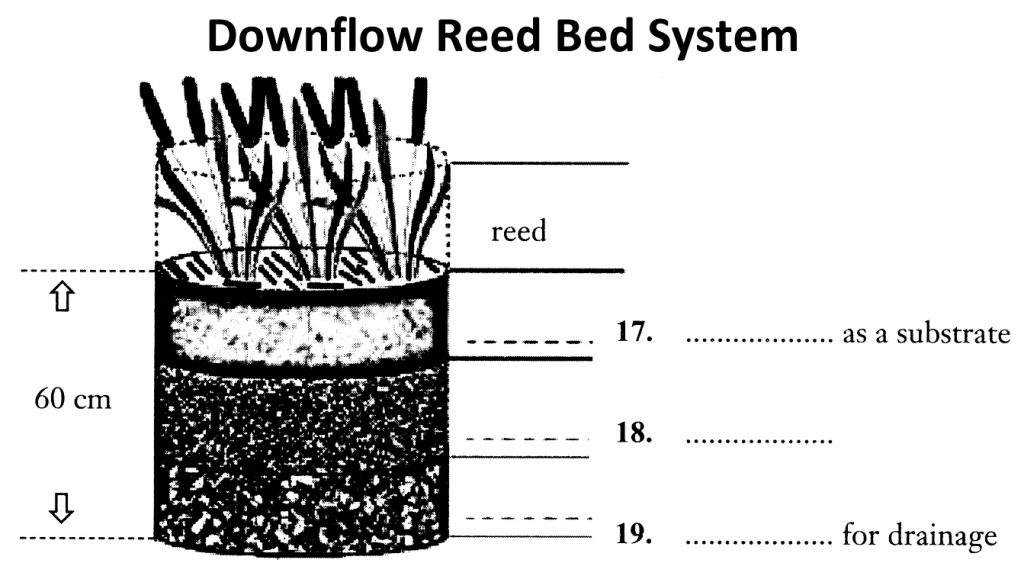
A vertical flow reed bed is a sealed, gravel-filled trench with reeds growing in it (see the picture below). The common reed oxygenates the water, which helps to create the right environment for colonies of bacteria to break down unwanted organic matter and pollutants. The reeds also make the bed attractive to wildlife.
How does a vertical flow reed bed work?
F
In vertical flow (Downflow) reed beds, the wastewater is applied on top of the reed bed, flows down through a rhizome zone with sludge as substrate, then the root zone with sand as substrate and followed by a layer of gravel for drainage, and is collected in an under drainage system of large stones. The effluent flows on to the surface of the bed and percolates slowly through the different layers into an outlet pipe, which leads to a horizontal flow bed and is cleaned by millions of bacteria, algae, fungi, and microorganisms that digest the waste, including sewage. There is no standing water so there should be no unpleasant smells.
G
Vertical flow reed bed systems are much more effective than horizontal flow reed-beds not only in reducing biochemical oxygen demanded (BOD) and suspended solids (SS) levels but also in reducing ammonia levels and eliminating smells. Usually considerably smaller than horizontal flow beds, but they are capable of handling much stronger effluents which contain heavily polluted matters and have longer lifetime value. A vertical reed bed system works more efficiently than a horizontal reed bed system, but it requires more management, and its reed beds are often operated for a few days then rested, so several beds and a distribution system are needed.
H
There are several advantages of Reed Bed systems over traditional forms of water treatment: first, they have low construction and running costs; second, they are easy management; third they have an excellent reduction of biochemical oxygen demand and suspended solids; last, they have a potential for efficient removal of a wide range of pollutants.
I
Reed beds are natural habitats found in floodplains waterlogged depressions and estuaries. The natural bed systems are a biologically proved, and an environmentally friendly and visually unobtrusive way of treating wastewater and have the extra virtue of frequently been better than mechanical wastewater treatment systems. In the medium to long term reed bed systems are, in most cases, more cost-effective in installment than any other wastewater treatment. They are robust and require little maintenance. They are naturally environmentally sound protecting groundwater, dams, creeks, rivers, and estuaries.
Questions 14-16
Do the following statements agree with the information given in Reading Passage 2?
In boxes 14-16 on your answer sheet, write
TRUE if the statement is true.
FALSE if the statement is false
NOT GIVEN if the information is not given in the passage.
14 The Reed bed system is a conventional method for water treatment in the urban area.
15 In the reed roots, there’s a series of process that helps breakdown the pollutants.
16 Escherichia coli is the most difficult bacteria to be dismissed.
Questions 17-19
Complete the diagram below.
Choose NO MORE THAN THREE WORDS OR A NUMBER from the passage for each answer.
Questions 20-24
Use the information in the passage to match the advantages and disadvantages of the two systems: horizontal flow system and downflow system (listed A-H) below.
Write the appropriate letters A-H in boxes 20-24 on your answer sheet.
20……….…………, which is the advantage of the down-flow system.
However, 21…………..………. and 22………..……… are the disadvantages of down-flow system
23………………and 24……….………… are the two benefits of the horizontal flow system. However, it’s less effective and efficient.
A It can deal with a more seriously polluted effluent.
B It requires more beds than one compared to the other.
C It needs less control and doesn’t need to be taken care of all the time.
D It requires a lot of guidance.
E It can’t work all the time because the pool needs time to rest and recover after a certain period.
F It’s a lot more complicated to build the system.
G The system is easy to be built which does not need an auxiliary system.
H It consumes less water.
Questions 25-26
Choose two correct letters from the following A, B, C, D, or E.
Write your answers in boxes 25-26 on your answer sheet.
What are the TWO benefits of natural bed systems when compared to conventional systems?
A Operation does not require electricity or fuel supply.
B They’re visually good and environmentally friendly.
C No mechanical systems are involved.
D They’re to be set up and used in less cost.
E They do not break down.
Passage 1
1. YES
2. YES
3. NOT GIVEN
4. FALSE
5. B
6. A
7. D
8. C
9. A
10. B
11. C
12. A
13. D
Passage 2
14. FALSE
15. TRUE
16. NOT GIVEN
17. sludge
18. sand
19. gravel
20. A
21. B
22. E
23. C
24. G
25. B
26. D
Passage 3
27. i
28. v
29. x
30. vii
31. ix
32. ii
33. vi
34. iv
35. B
36. C
37. B
38. G
39. H
40. D

Bình luận