


READING PASSAGE 1
You should spend about 20 minutes on Questions 1-13 which are based on Reading Passage 1 below.
THE BATTLE OF TOWTON
March 29th, 1461, in tiny Towton was one of the bloodiest days in English history, yet only recently have a small number of soldiers’ bodies undergone exhumation and examination. Several thousand still lie buried in mass graves on the battlefield. Early analysis of the remains has led to a reassessment of medieval warfare.
Towton, a village in the north of England, between York and Leeds, is unknown to many English people. History taught at school largely ignores the mid-15th century. Towton itself has neither museum nor large memorial, merely a roadside cross to mark where the battle took place.
In 1996, a building nearby called Towton Hall was being renovated when labourers unearthed skeletons in its grounds and beneath its floor. Twenty-eight of these were complete; another 20 or so were partial. What shocked archaeologists were the violent way in which the men had met their deaths and the callous manner of their burial. We are all familiar with the gory wars of the 20th century and might assume that technology and politics have become more destructive over time. However, it could be the case that humans have long been vicious – only now is the evidence coming to light.
So what was the Battle of Towton? It was one clash of many between two powerful families –the Lancastrians and the Yorkists – who each wanted their king to rule England. The Lan castrians believed the current King of England, Henry VI, was incapable if not insane, whereas the Yorkists, led by Richard Plantagenet, supported Henry since he had chosen Richard as the next king. When Richard was killed in 1460, his son Edward, only 18, vowed to assume the throne in his father’s place. Needless to say, the Lancastrians disputed this. Effectively, the Battle of Towton would legitimate Edward’s reign.
Prior to Towton, military encounters in England had been small-scale: battles were fought with hundreds or at most a few thousand men, and no army was professional. In so-called peacetime, private armies consisted of men – ranging in age from 15 to 50 – whose levels of fitness were variable, and whose training and equipment was poor. This meant that when fighting did erupt, it seldom lasted long – perhaps just a few days. Nor were many men killed. In fact, there is evidence that more men died from their wounds or other illnesses after combat. Towton it seems was different, for here was a battle in which both sides assembled large armies, and there were terrible casualties in the field.
The number of soldiers killed at Towton is a matter of speculation as few records have come down to us, and those that do survive may have exaggerated the victory of King Edward IV, as Edward became, in order to intimidate his enemies. One estimate of the dead is 28,000 out of the 75,000 soldiers who took part. These 75,000 represent 10% of all fighting-age men in England at the time – the total population being just three million. Twenty-eight thousand dead on one day is, therefore, a staggering number.
As injuries show on the skeletons of soldiers already studied, those men were hacked to death, shot by arrows, or trampled by horses. Some of the first bullets used in England were fired that day. Lead-composite shot has been dug up on the battlefield, and one archaeologist claims to have found part of a handgun, but there are no obvious deaths from guns, and it is hard to say how they were used. The most effective weapon was the poleaxe – a long, heavy iron weapon with a sharp tip, a small axe blade on one side and, on the other, a large sharp head like a Philips-head screwdriver. It was used to kill soldiers who were running away as battle lines broke up, and it is thought this is how most of the Lancastrians buried at Towton Hall died.
It is not known why the death rate in this battle was so high, nor why the bodies of soldiers were so disfigured. Skeletal evidence indicates that often a dozen blows were given to a man who would have been killed by the initial two or three. Archaeologists are uncertain when these additional blows were made – on the battlefield or in the burial process – but such savagery suggests the emergence of a new concept of an opponent as not merely someone to kill but someone whose identity should be utterly effaced. After death, in a ritual never before seen in English warfare, soldiers were stripped of their clothes and tossed into mass graves to further dehumanise them.
It is easy to forget that in medieval England burial was sacred, and people believed ascent to Heaven only took place when the body of the dead was whole. In all Europe, there is only one other known mass grave on the scale of Towton from around the same time – that is in Sweden from 1361. There, however, soldiers from the Battle of Wisby were buried whole in their armour.
It appears that the savagery of the Yorkists did effect submission since Edward remained king for the next 22 years.
Today, at Towton, work continues on excavation and analysis of the medieval skeletons. Theories about a new kind of violent warfare and the purpose of mass graves abound. It seems that organised brutality is no recent phenomenon; it existed 550 years ago.
Questions 1-5
Complete the summary below.
Choose ONE WORD OR A NUMBER from the passage for each answer.
Write your answers in boxes 1-5 on your answer sheet.
The battlefield at Towton in northern England has only recently been surveyed and excavated. Archaeologists are now looking at medieval 1 ……………………. in a new way. Although a major battle took place at Towton, this is not popular knowledge for English people as the battle is not studied at 2 …………………….. .
In 1996, soldiers’ skeletons were found under a building near Towton. 3 ………………………
of these had all their bones. This meant archaeologists could accurately determine how the
soldiers had died. The archaeologists were very surprised by the 4 ……………………. means of
death, and the uncaring method of 5 ……………………. .
Questions 6-9
What are the following statements according to information in the passage?
In boxes 6-9 on your answer sheet, write:
TRUE if the statement agrees with the information
FALSE if the statement contradicts the information
NOT GIVEN if there is no information on this
6 The Battle of Towton was part of a war between two families seeking control over
England.
7 Soldiers who fought at Towton were better trained than in the past.
8 Ten percent of all soldiers in England died at Towton.
9 Guns killed many soldiers at Towton.
Questions 10-13
Choose the correct letter: A, B, C, or D.
Write the correct letter in boxes 10-13 on your answer sheet.
10 Most Lancastrians were killed
A fleeing the Yorkists.
B at Towton Hall.
C in prison.
D fighting in lines on the battlefield.
11 At Towton, it is likely soldiers’ bodies were cut up and buried in mass graves
A as this was common practice at the time.
B because King Edward IV was against religion.
C since Yorkists hated Lancastrians.
D so opponents of King Edward IV would live in fear.
12 Soldiers who died in a Swedish battle in 1361
A were also killed with poleaxes.
B went to Heaven.
C were buried in individual graves.
D were buried more respectfully.
13 A suitable title for this passage would be:
A Towton: a forgotten battle in English history
B The horrors of warfare in an age before guns
C Modern savagery in medieval Towton
D Towton: a turning point in military techniques
READING PASSAGE 2
You should spend about 20 minutes on Questions 14-27 which are based on Reading Passage 2 below.
HARD-PASTE PORCELAIN
Definition and origin
The term porcelain refers to ceramics made from similar materials and baked at high temperatures which are light, durable, and vitreous.* Porcelain combines the positive qualities of glass and clay – glass is smooth and translucent while clay retains its shape when moulded. However, due to the addition of a few more minerals, porcelain is stronger than either glass or clay. It is also extremely beautiful and valuable: Chinese Ming Dynasty (1368-1644 AD) bowls can fetch a million dollars on the international art market.
For around fifteen hundred years, porcelain has been employed as tableware and decoration, but its more recent applications include dental crowns and electrical insulators.
Porcelain was first made in China. During the Tang Dynasty (618-907 AD), small amounts were used by the court and the very rich. High-quality porcelain, like that manufactured today, was not widely available until the Yuan Dynasty (1279-1368 AD).
Chinese porcelain was traded with kingdoms in Central, Southeast Asia, and the Middle East from the seventh century. By the Middle Ages, it had reached Europe.
European obsession
Porcelain was consumed in enormous quantities by European royal families, nobles, and the church, all of whom tried desperately to discover its chemical composition. The English word, ‘porcelain’, derives from the Portuguese name for a sea creature, the nautilus, which has a spiral orange vitreous shell from which it was believed at one time that porcelain was made. Other more astute Europeans contended the ceramic contained crushed glass or bone.
Early experiments in the production of porcelain included adding ground glass to clay. The result is called ‘soft-paste’ as it is weaker than true porcelain.
So great was the frenzy for possessing Chinese porcelain, or attempting to recreate their own hard-paste, that a number of European principalities endangered themselves financially, spending as much of their budgets on pursuing porcelain as on their armies. Frederick II of Prussia (now in Germany) was one such fanatic. Fortunately, for Prussia, two scientists – Johann Böttger and Ehrenfried von Tschimhaus – in the monarch’s service, solved the porcelain puzzle. Their discovery, made in 1707, combined clay with ground feldspar – a mineral containing aluminium silicate.
Meanwhile, in England, the recipe was a little different: ash, from cattle bones, was mixed with clay, feldspar, and quartz. This became known as ‘bone china’ and is still manufactured. Although not true porcelain, it remains popular in the US and the UK because it is harder than porcelain.
Constituents
The raw materials from which porcelain is made are abundant. They are white clay (china clay or ball clay), feldspar, or perhaps flint, and silica – all of which are noted for their small articles. Feldspar and flint are used as fluxes, which reduce the temperature needed for firing and bind the glass, silica, and clay granules. Porcelain may also contain other ingredients like alumina or steatite.
Manufacture
To produce porcelain, the raw materials are selected and weighed. Then, they are crushed in a two-stage process. Jaw crushers work first; mullers or hammer mills subsequently reduce particles to 0.25cms (0.1 inch) or less in diameter. A third crushing, using ball mills, takes place for the finest porcelain. During purification, which follows, granules that are not of uniform size are screened out. Magnetic filtration then removes iron, commonly found in clay, because this prevents the porcelain from forming correctly. The fifth stage, preparatory to firing, is formation. There are several types of formation by hand or machine. After formation, the ware undergoes its initial firing in a kiln – a special oven.
A glaze is a glassy liquid similar in composition to porcelain. If a porcelain object is painted, a glaze covers the paint, or its decoration may just be the glaze. Glaze is applied by painting or dipping and takes place after the first firing. Not only are porcelain wares gorgeous, but their decoration and glazing are also of great interest.
In making porcelain, the temperature in the kiln is critical – high enough to reconstitute the elements, yet low enough to vaporise contaminants and minimise shrinkage. A typical temperature is 1454° Celsius (2650° Fahrenheit).
During the firing process, a number of chemical reactions occur. Carbon-based impurities burn out at 100-200°C (215-395°F). As the kiln is heated, carbonates and sulfates decompose. When heated to 700-1100°C (1295-2015°F), the fluxes react with the decomposing minerals to form liquid glass. After a certain density is reached, at around 1200°C (2195°F), the ware is cooled, causing the liquid glass to solidify.
Pause for thought
So, next time you dine from fine porcelain, take a moment to reflect on the complicated history and sophisticated manufacture of this exquisite product.
——————————————–
* Having a glassy appearance
Questions 14-18
For which places are the following statements about porcelain true?
In boxes 14-18 on your answer sheet, write:
A China
B Europe
C Both China and Europe
14 Here, dishes have sold for very high prices.
15 It was first invented here.
16 Its English name comes from here.
17 Military and porcelain expenditure was equal in some places here.
18 Here ‘bone china’ was produced.
Questions 19-23
Label the stages in the process below.
Choose NO MORE THAN TWO WORDS OR A NUMBER from the passage for each answer.
Write your answers in boxes 19-23 on your answer sheet.
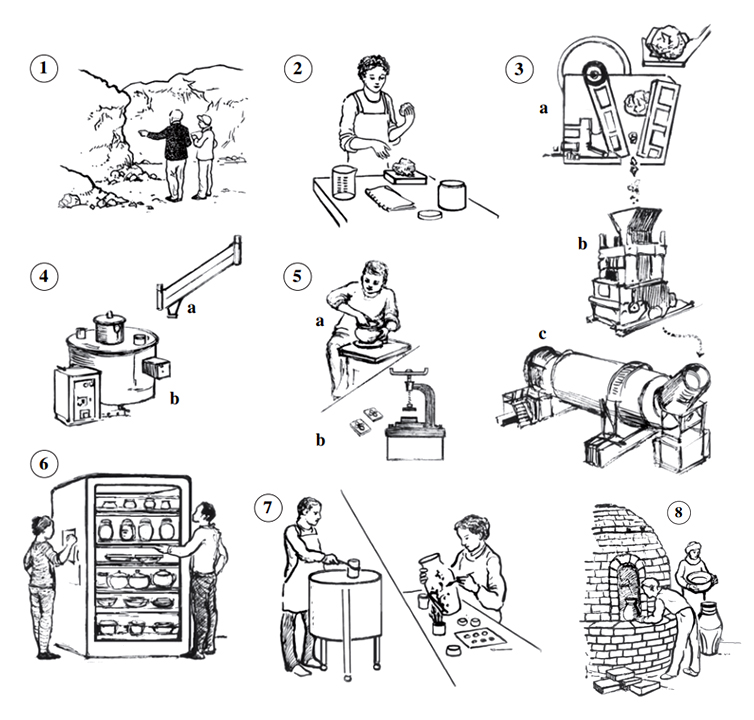
1 Selection of 19 ………………………….
2 Weighing
3 Crushing: a. Jaw crushers
b. Mullers/hammer mills – particles < 20 ……………………….. in diameter
c. Smaller particles for finer porcelain
4 21 …………………………. : a. Non-uniform granules screened out
b. Iron removed by magnetic filtration
5 Formation: a. Manual b. Mechanical
6 22 …………………………. : Wares placed in a kiln and baked
7 Decoration: 23 …………………………. and/or painting
8 Second firing
Questions 24-27
Complete the notes below.
Choose ONE WORD OR A NUMBER from the passage for each answer.
Write your answers in boxes 24-27 on your answer sheet.
FIRING PORCELAIN
|
Chemical |
Event |
Temperature range |
|
1 |
Carbon-based impurities 24 …………………. out |
100-200° C |
|
2 |
Temperature rises inside 25 …………………. → |
|
|
3 |
Fluxes + decomposing minerals → liquid glass |
26 ………-1100° C |
|
4 |
Density reached: liquid glass begins to |
c 1200-1454° C |
|
Cooling |
Porcelain complete |
c 1454-15° C |
Passage 1
1. warfare
2. school
3. 28/Twenty-eight (capital optional)
4. violent
5. burial
6. TRUE
7. NOT GIVEN
8. FALSE
9. FALSE
10. A
11. D
12. D
13. C
Passage 2
14. C
15. A
16. B
17. B
18. B
19. Raw materials (capital optional)
20. 0.25 cm/0.1 inch
21. Purification (capital optional)
22. First/ Initial firing (capital optional)
23. glazing
24. burn
25. kiln
26. 700
27. solidify
Passage 3
28. land
29. poor
30. aid
31. business/ traders
32. communities
33. China (capital optional)
34. geography
35. investment
36. education
37. 34/thirty-four
38. suffering
39. C
40. E

Bình luận