


READING PASSAGE 1
You should spend about 20 minutes on Questions 1-13 which are based on Reading Passage 1 below.
Biomimetic Design
What has fins like a whale, skin like a lizard, and eyes like a moth? The future of engineering. Andrew Parker, an evolutionary biologist, knelt in the baking red sand of the Australian outback just south of Alice Springs and eased the right hind leg of a thorny devil into a dish of water.
A
“Its back is completely drenched!” Sure enough, after 30 seconds, water from the dish had picked up the lizard’s leg and was glistening all over its prickly hide. In a few seconds more the water reached its mouth, and the lizard began to smack its jaws with evident satisfaction. It was, in essence, drinking through its foot. Given more time, the thorny devil can perform this same conjuring trick on a patch of damp sand – a vital competitive advantage in the desert. Parker had come here to discover precisely how it does this, not from purely biological interest, but with a concrete purpose in mind: to make a thorny-devil-inspired device that will help people collect lifesaving water in the desert. “The water’s spreading out incredibly fast!” he said, as drops from his eyedropper fell onto the lizard’s back and vanished, like magic. “Its skin is far more hydrophobic than I thought. There may well be hidden capillaries, channeling the water into the mouth.”
B
Parker’s work is only a small part of an increasingly vigorous, global biomimetics movement. Engineers in Bath, England, and West Chester, Pennsylvania, are pondering the bumps on the leading edges of humpback whale flukes to learn how to make airplane wings for more agile flight. In Berlin, Germany, the fingerlike primary feathers of raptors are inspiring engineers to develop wings that change shape aloft to reduce drag and increase fuel efficiency. Architects in Zimbabwe are studying how termites regulate temperature, humidity, and airflow in their mounds in order to build more comfortable buildings, while Japanese medical researchers are reducing the pain of an injection by using hypodermic needles edged with tiny serrations, like those on a mosquito’s proboscis, minimizing nerve stimulation.
C
Ronald Fearing, a professor of electrical engineering at the University of California, Berkeley, has taken on one of the biggest challenges of all: to create a miniature robotic fly that is swift, small, and maneuverable enough for use in surveillance or search-and-rescue operations. Fearing made his own, one of which he held up with tweezers for me to see, a gossamer wand some 11 millimeters long and not much thicker than a cat’s whisker. Fearing has been forced to manufacture many of the other minute components of his fly in the same way, using a micromachining laser and a rapid prototyping system that allows him to design his minuscule parts in a computer, automatically cut and cure them overnight, and assemble them by hand the next day under a microscope.
D
With the micro laser he cuts the fly’s wings out of a two-micron polyester sheet so delicate that it crumples if you breathe on it and must be reinforced with carbon-fiber spars. The wings on his current model flap at 275 times per second – faster than the insect’s own wings – and make the blowfly’s signature buzz. “Carbon fiber outperforms fly chitin,” he said, with a trace of self-satisfaction. He pointed out a protective plastic box on the lab bench, which contained the fly-bot itself, a delicate, origami-like framework of black carbon-fiber struts and hairlike wires that, not surprisingly, looks nothing like a real fly. A month later it achieved liftoff in a controlled flight on a boom. Fearing expects the fly-bot to hover in two or three years, and eventually to bank and dive with flylike virtuosity.
E
Stanford University roboticist Mark Cutkosky designed a gecko-insured climber that he christened Stickybot. In reality, gecko feet aren’t sticky – they’re dry and smooth to the touch – and owe their remarkable adhesion to some two billion spatula-tipped filaments per square centimeter on their toe pads, each filament only a hundred nanometers thick. These filaments are so small, in fact, that they interact at the molecular level with the surface on which the gecko walks, tapping into the low-level van der Waals forces generated by molecules’ fleeting positive and negative charges, which pull any two adjacent objects together. To make the toe pads for Stickybot, Cutkosky and doctoral student Sangbae Kim, the robot’s lead designer, produced a urethane fabric with tiny bristles that end in 30-micrometer points. Though not as flexible or adherent as the gecko itself, they hold the 500-gram robot on a vertical surface.
F
Cutkosky endowed his robot with seven-segmented toes that drag and release just like the lizard’s, and a gecko-like stride that snugs it to the wall. He also crafted Stickybot’s legs and feet with a process he calls shape deposition manufacturing (SDM), which combines a range of metals, polymers, and fabrics to create the same smooth gradation from stiff to flexible that is present in the lizard’s limbs and absent in most man-made materials. SDM also allows him to embed actuators, sensors, and other specialized structures that make Stickybot climb better. Then he noticed in a paper on gecko anatomy that the lizard had to branch tendons to distribute its weight evenly across the entire surface of its toes. Eureka. “When I saw that, I thought, wow, that’s great!” He subsequently embedded a branching polyester cloth “tendon” in his robot’s limbs to distribute its load in the same way.
G
Stickybot now walks up vertical surfaces of glass, plastic, and glazed ceramic tile, though it will be some time before it can keep up with a gecko. For the moment it can walk only on smooth surfaces, at a mere four centimeters per second, a fraction of the speed of its biological role model. The dry adhesive on Stickybot‘s toes isn’t self-cleaning like the lizard’s either, so it rapidly clogs with dirt. “There are a lot of things about the gecko that we simply had to ignore,” Cutkosky says. Still, a number of real-world applications are in the offing. The Department of Defense’s Defense Advanced Research Projects Agency (DARPA), which funds the project, has it in mind for surveillance: an automaton that could slink up a building and perch there for hours or days, monitoring the terrain below. Cutkosky hypothesizes a range of civilian uses. “I’m trying to get robots to go places where they’ve never gone before,” he told me. “I would like to see Stickybot have a real-world function, whether it’s a toy or another application. Sure, it would be great if it eventually has a lifesaving or humanitarian role…”
H
For all the power of the biomimetics paradigm, and the brilliant people who practice it, bio-inspiration has led to surprisingly few mass-produced products and arguably only one household word – Velcro, which was invented in 1948 by Swiss chemist George de Mestral, by copying the way cockleburs clung to his dog’s coat. In addition to Cutkosky‘s lab, five other high-powered research teams are currently trying to mimic gecko adhesion, and so far none has come close to matching the lizard’s strong, directional, self-cleaning grip. Likewise, scientists have yet to meaningfully re-create the abalone nanostructure that accounts for the strength of its shell, and several well-funded biotech companies have gone bankrupt trying to make artificial spider silk.
Questions 1-7
Do the following statements agree with the information given in Reading Passage?
In boxes 1-7 on your answer sheet, write
TRUE if the statement agrees with the information
FALSE if the statement contradicts the information
NOT GIVEN if there is no information on this
1 Andrew Parker failed to make effective water device which can be used in desert.
2 Skin of lizard is easy to get wet when it contacts water.
3 Scientists apply inspiration from nature into many artificial engineering.
4 Tiny and thin hair under gecko’s feet allows it to stick to the surface of object.
5 When gecko climbs downward, its feet release a certain kind of chemical to make them adhesive.
6 Famous cases stimulate a large number of successful products of biomimetics in real life.
7 Velcro is well-known for its bionics design.
Questions 8-10
Filling the blanks below.
Write NO MORE THAN THREE WORDS AND/OR A NUMBER from the passage for each question of robot below.
Ronald Fearing was required to fabricate tiny components for his robotic fly 8…………………… by specialized techniques.
The robotic fly’s main structure outside is made of 9 …………………… and long and thin wires which make it unlike fly at all.
Cutkosky applied an artificial material in Stickybot’s 10 …………………… as a tendon to split pressure like lizard’s does.
Questions 11-13
Fill the blanks below.
Write NO MORE THAN THREE WORDS AND/OR A NUMBER from the passage for each answer about facts of stickybot.
11 Stickybot’s feet doesn’t have …………………… function which makes it only be able to walk on smooth surface.
12 DARPA is planning to use stickybot for …………………….
13 Cutkosky assumes that stickybot finally has potential in …………………… or other human-related activities.
READING PASSAGE 2
You should spend about 20 minutes on Questions 14-26 which are based on Reading Passage 2 below.
Undersea Movement
A
The underwater world holds many challenges. The most basic of these is movement. The density of water makes it difficult for animals to move. Forward movement is a complex interaction of underwater forces. Additionally, water itself has movement. Strong currents carry incredible power that can easily sweep creatures away. The challenges to aquatic movement result in a variety of swimming methods, used by a wide range of animals. The result is a dazzling underwater ballet.
B
Fish rely on their skeleton, fins, and muscles to move. The primary function of the skeleton is to aid movement of other parts. Their skull acts as a fulcrum and their vertebrae act as levers. The vertebral column consists of a series of vertebrae held together by ligaments, but not so tightly as to prevent slight sideways movement between each pair of vertebrae. The whole spine is, therefore, flexible. The skull is the only truly fixed part of a fish. It does not move in and off itself but acts as a point of stability for other bones. These other bones act as levers that cause movement of the fish’s body.
C
While the bones provide the movement, the muscles supply the power. A typical fish has hundreds of muscles running in all directions around its body. This is why a fish can turn and twist and change directions quickly. The muscles on each side of the spine contract in a series from head to tail and down each side alternately, causing a wave-like movement to pass down the body. Such a movement may be very pronounced in fish such as eels, but hardly perceptible in others, e.g. mackerel. The frequency of the waves varies from about 50/min in the dogfish to 170/min in the mackerel. The sideways and backward thrust of the head and body against the water results in the resistance of the water pushing the fish sideways and forwards in a direction opposed to the thrust. When the corresponding set of muscles on the other side contracts, the fish experiences a similar force from the water on that side. The two sideways forces are equal and opposite unless the fish is making a turn, so they cancel out, leaving the sum of the two forward forces
D
The muscles involved in swimming are of two main types. The bulk of a fish’s body is composed of the so-called white muscle, while the much smaller areas at the roots of the fins and in a strip along the centre of each flank comprise red muscle. The red muscle receives a good supply of blood and contains ampler quantities of fat and glycogen, the storage form of glucose, which is used for most day-to-day swimming movements. In contrast, the white muscle has a poor blood supply and few energy stores, and it is used largely for short-term, fast swimming. It might seem odd that the body of an animal which adapts adapted so efficiently to its environment should be composed almost entirely of a type of muscle it rarely uses. However, this huge auxiliary power pack carried by a fish is of crucial significance if the life of the fish is threatened-by a predator, for instance-because it enables the fish to swim rapidly away from danger.
E
The fins are the most distinctive features of a fish, composed of bony spines protruding from the body with skin covering them and joining them together, either in a webbed fashion, as seen in most bony fish, or more similar to a flipper, as seen in sharks. These usually serve as a means for the fish to swim. But it must be emphasized that the swimming movements are produced by the whole of the muscular body, and in only a few fish do the fins contribute any propulsive force! Their main function is to control the stability and direction of the fish: as water passes over its body, a fish uses its fins to thrust in the direction it wishes to go.
F
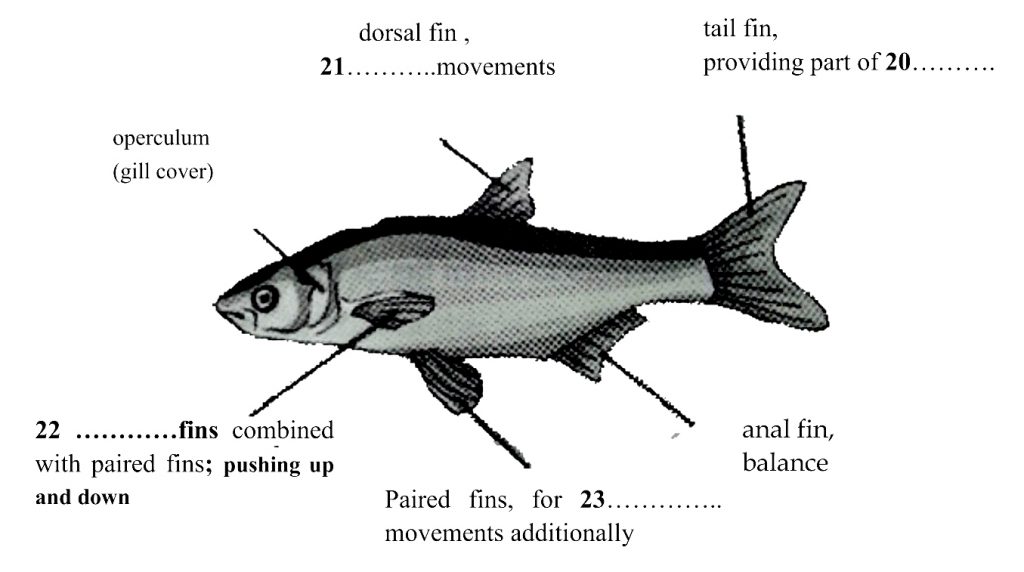
Fins located in different places on a fish serve different purposes, such as moving forward, turning, and keeping an upright position. The tail fin, in its final lash may contribute as much as 40 per cent of the forward thrust. The median fins, that is, the dorsal, anal and ventral fins, control the rolling and yawing movements of the fish by increasing the vertical surface area presented to the water. The paired fins, pectoral and pelvic act as hydroplanes and control the pitch of the ash, causing it to swim downwards or upwards according to the angle to the water at which they are held by their muscles. The pectoral fins lie in front of the centre of gravity and, being readily mobile, are chiefly responsible for sending the ash up or down. The paired ins are also the means by which the fish slows down and stops.
G
The swimming speed of fish is not so fast as one would expect from watching their rapid movements in aquaria or ponds. Tuna seems to be the fastest at 44 mph, trout are recorded as doing 23 mph, pike 20 mph for short bursts and roach about 10 mph, while the majority of small fish probably do not exceed 2 or 3 mph. Many people have attempted to make accurate measurements of the speed at which various fish swim, either by timing them over known distances in their natural environment or by determining their performance in man-made swimming channels. From these studies, we can broadly categorise fish into four groups: “sneakers”, such as eels that are only capable of slow speeds but possess some staying power; “stayers”, that can swim quite fast over long periods; “sprinters” that can generate fast bursts of speed (e.g. pike); and “crawlers” that are sluggish swimmers, although they can accelerate slightly (bream, for example).
H
One type of sailfish is considered to be the fastest species of fish over short distances, achieving 68 mph over a three-second period, and anglers have recorded speeds in excess of 40 mph over longer periods for several species of tuna. One is likely to consider a fish’s swimming capabilities in relation to its size. However, it is generally true that a small fish is a more able swimmer than a much larger one. On the other hand in terms of speed in miles per hour, a big fish will, all other things being equal, be able to swim faster than a smaller fish.
Questions 14-19
The Passage has 8 paragraphs A-H.
Which paragraph contains the following information?
Write the appropriate letter, A-H, in boxes 14-19 on your answer sheet.
14 categorizations of fish by swimming speed
15 an example of fish capable of maintaining fast swimming for a long time
16 how fish control stability
17 frequency of the muscle movement of fish
18 a mechanical model of fish skeleton
19 energy storage devices in a fish
Questions 20-23
The diagram below gives information about fish fins and their purposes.
Complete the diagram with NO MORE THAN THREE WORDS from the passage for each blank
Write your answers in boxes 20-23 on your answer sheet.
Questions 24-26
Complete the summary below using NO MORE THAN THREE WORDS from the passage for each blank.
Write your answers in boxes 24-26 on your answer sheet.
Two types of muscles are involved in fish swimming. The majority of a fish’s body comprises the 24………………, and the red muscle is found only at the roots of the fins and in a strip along the centre of each flank. For most of its routine movements, the fish uses a lot of its 25……………… saved in body, and white muscle is mostly used for short-term, fast swimming, such as escaping from 26………………
Passage 1
1. NOT GIVEN
2. FALSE
3. TRUE
4. FALSE
5. NOT GIVEN
6. FALSE
7. TRUE
8. the same way
9. carbon-fiber
10. limbs/ legs and feets
11. self-cleaning
12. surveillance
13. lifesaving
Passage 2
14. G
15. H
16. E
17. C
18. B
19. D
20. forward thrust
21. rolling and yawing
22. Pectoral and pelvic
23. slows and stops
24. white muscle
25. fats and glycogen
26. predator/danger
Passage 3
27. vii
28. iv
29. vi
30. v
31. viii
32. iii
33. combustion engine
34. silent
35. battery
36. portable computers
37. FALSE
38. NOT GIVEN
39. TRUE
40. TRUE

Bình luận